about

The Object of the Week blog is written by Cooper Hewitt’s curators, graduate fellows, and contributing researchers and scholars. Posts are published every week and present research on an object from the museum’s collection. With over 210,000 objects spanning thirty centuries of decorative arts and design, Object of the Week explores the material culture of textiles, graphic design, furniture, products, architectural drawings, wallcoverings, and much more.
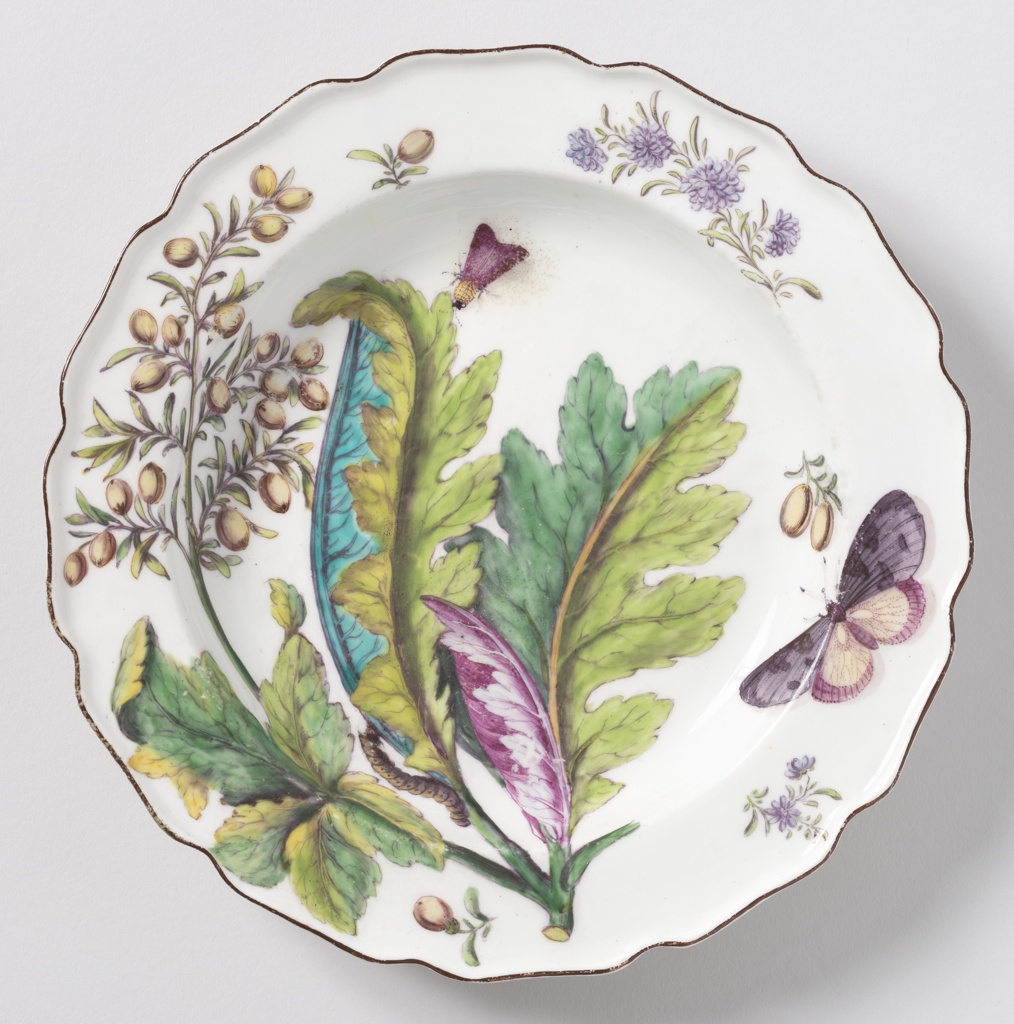
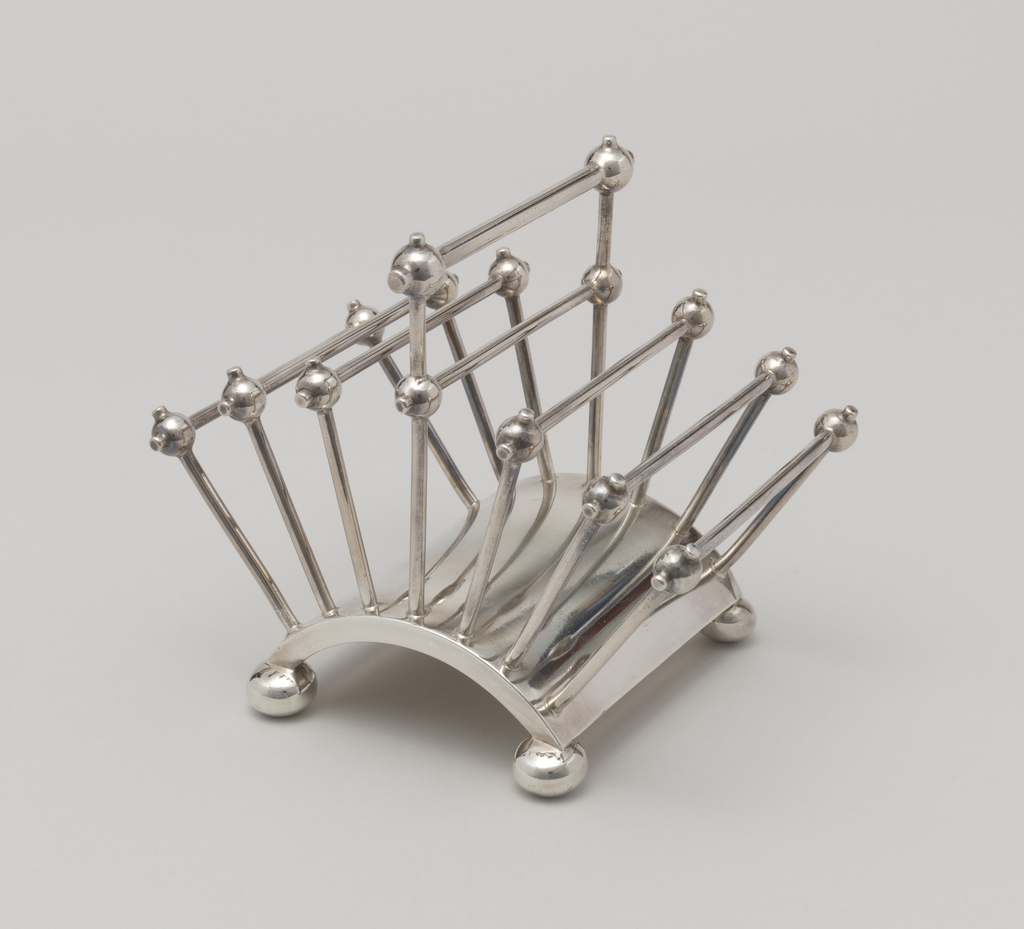
Image features a circular white plate with a wavy, brown-edged rim surrounding colorful painted decoration of a branch of bocconia/parrot weed (Bocconia frutescens) leaves, various sprigs, a caterpillar, and two winged insects. Please scroll down to read the blog post about this object.
Natural History for Dinner
To celebrate the opening of Nature by Design: Botanical Expressions (December 7, 2019-January 10, 2021), Object of the Day this week will feature objects from the exhibition. The creation of what has come to be known as Hans Sloane plates derived from an increased interest in natural history in the eighteenth century, which led to...
Image features a silver-plated toast rack with seven square dividers composed of vertical posts and horizontal rods connected by ball joints, the center one with an extra raised section to serve as a handle, all on a curved base resting on four bun feet. Please scroll down to read the blog post about this object.
The Geometry of Nature
To celebrate the opening of Nature by Design: Botanical Expressions (December 7, 2019-January 10, 2021), Object of the Day this week will feature objects from the exhibition. Christopher Dresser (1834-1904) is often described as the first independent industrial designer because of his belief in machine production, his ability to create beautiful and functional objects in...
Image features
Beyond the Crystal Palace
To celebrate the opening of Nature by Design: Botanical Expressions (December 7, 2019-January 10, 2021), Object of the Day this week will feature objects from the exhibition. Sir Joseph Paxton’s name may sound familiar to architecture enthusiasts, as he was responsible for designing the famous Crystal Palace of 1851 in London. The construction, which housed...
Image features a tall conical vase with a narrow neck and flaring mouth, the opaque glass body showing peach- and amber-colored flowers on a yellow to deep crimson background. Please scroll down to read the blog post about this object.
Vitrified Nature
To celebrate the opening of Nature by Design: Botanical Expressions (December 7, 2019-January 10, 2021), Object of the Day this week will feature objects from the exhibition. Growing up in Nancy, France, in the 1850s, Emile Gallé liked going to the city’s botanical gardens and walking the surrounding countryside of Lorraine. His interest in nature...
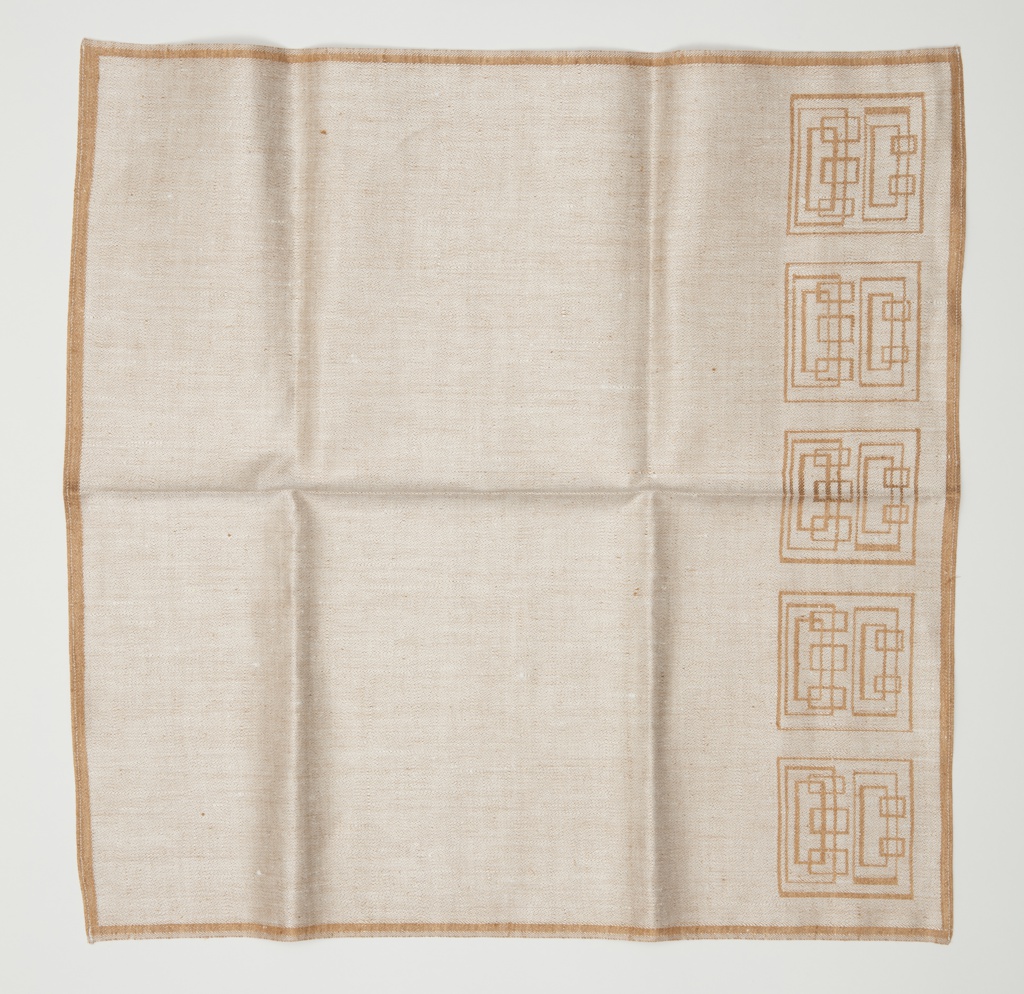
Image features a linen damask napkin with a geometric design of interlocking squares along one edge, in light tawny brown. Please scroll down to read the blog post about this object.
Dora’s Damask
The name Dora Jung (Finnish, 1906-1980) is closely associated with damask weaving, a technique in which the shiny face of satin weave and its matte reverse are manipulated to create subtle patterns. Over the course of her long career, Jung developed a variety of new techniques in damask patterning though her experiments in hand-weaving wall...
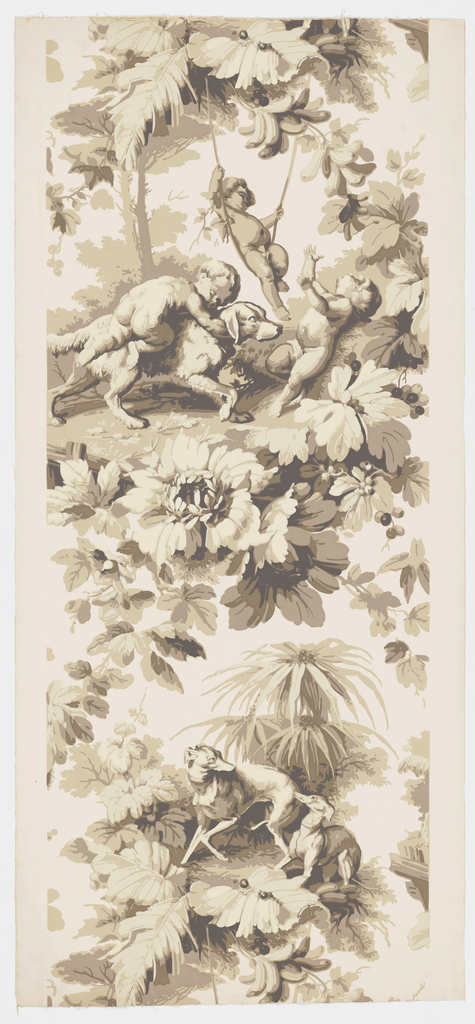
Image features a wallpaper with two landscape views containing boys and dogs, surrounded by lush tropical foliage. Please scroll down to read the blog post about this object.
Boys and Dogs
This is a reproduction wallpaper about which very little is known. The Diament company was an importer so presumably the paper came from Europe. It closely copies a paper originally produced by the Parisian firm Jules Desfossé in 1856, woodblock-printed in five colors. The design is divided into two separate views: the top view shows...
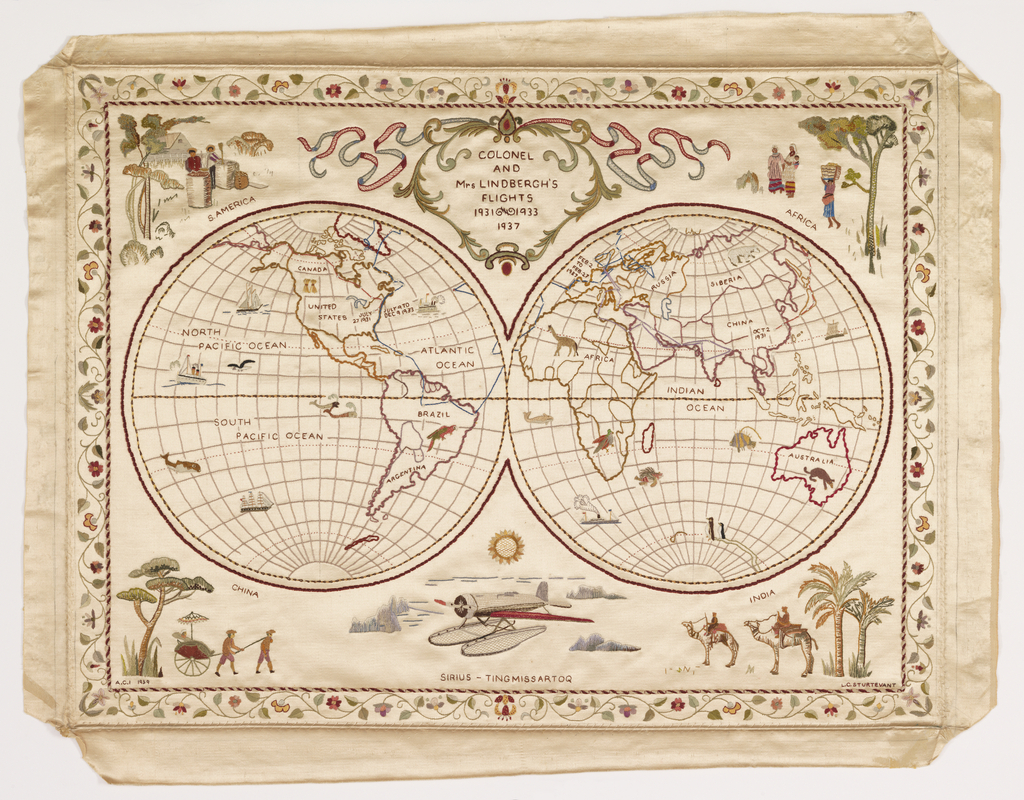
Image features a map sampler showing the globe in two hemispheres, tracing the flights of Colonel and Mrs. Lindbergh in 1931, 1933, and 1937. There are scenes in each corner labeled S. America, Africa, China, and India. At the bottom center, there is a plane labeled the Sirius-Tingmissartoq. The map is surrounded by a scrolling floral border. Please scroll down to read the blog post about this object..
Flight Adventures Stitched in Time
Author: Madelyn Shaw This silk embroidery, titled “Colonel and Mrs. Lindbergh’s Flights – 1931 – 1933 – 1937,” is an extraordinary take on the tradition of the map sampler. Embroidered lines in blue, gray, and red trace the routes that Charles and Anne Morrow Lindbergh took on a few of their 1930s flights: in 1931,...
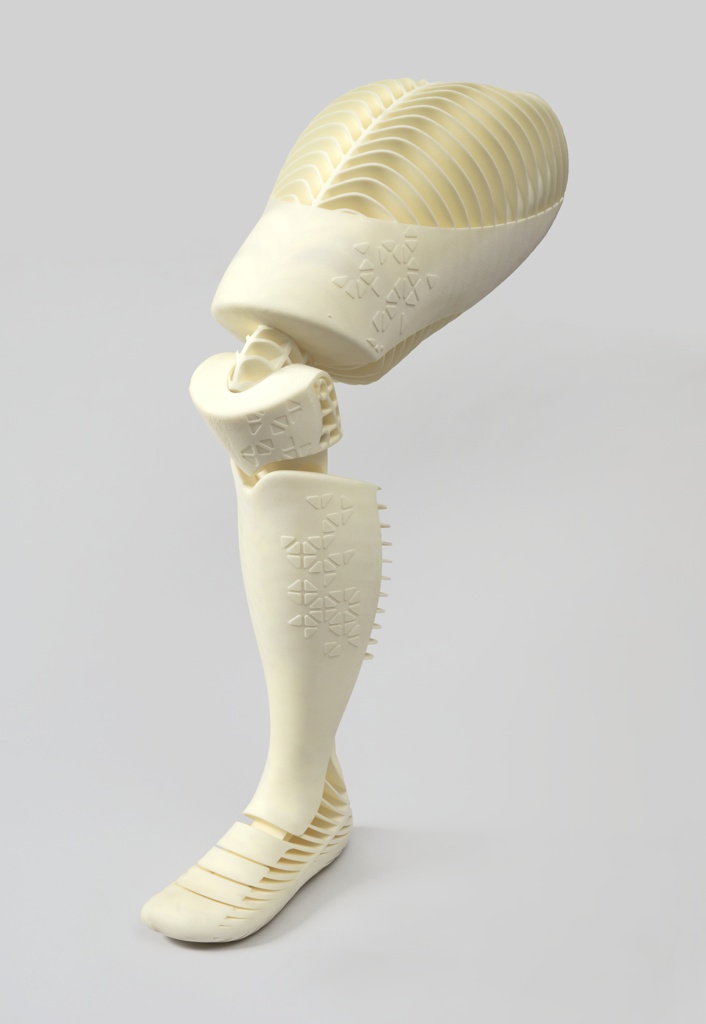
Image features a white nylon prosthetic leg spanning mid-thigh to foot; hollow form, jointed to bend at knee and foot. Please scroll down to read the blog post about this object.
Next Steps in Prosthetics
This 3D-printed artificial limb prototype represents the use of innovative digital manufacturing technology to meet the enduring need for prosthetics, which has been experienced by individuals around the world and at all economic levels. This technology requires no medical specialists, only access to a tablet-based application and an easy-to-use scanner. This is of particular relevance to the...
Image features a poster consisting of white text on a black background. Upper center: The words "VISUAL AIDS" are printed with a cracked effect. Columns of text appear on the bottom with the names of arts organizations. Above the columns, in slightly larger, bolder text: “A Day Without Art December 1, 1989 A national day of mourning and call for action in response to the AIDS / crisis involving individuals and organizations including the following:”. Please scroll down to read the blog post about this object.
Day Without Art at Thirty
World AIDS Day (December 1), was designated in 1988 as an occasion to raise awareness of AIDS and to commemorate those lost to the disease. Developed by Visual AIDS, an organization that supports artists and communities affected by HIV and AIDS, this poster announces the first Day Without Art on December 1, 1989. Day Without...
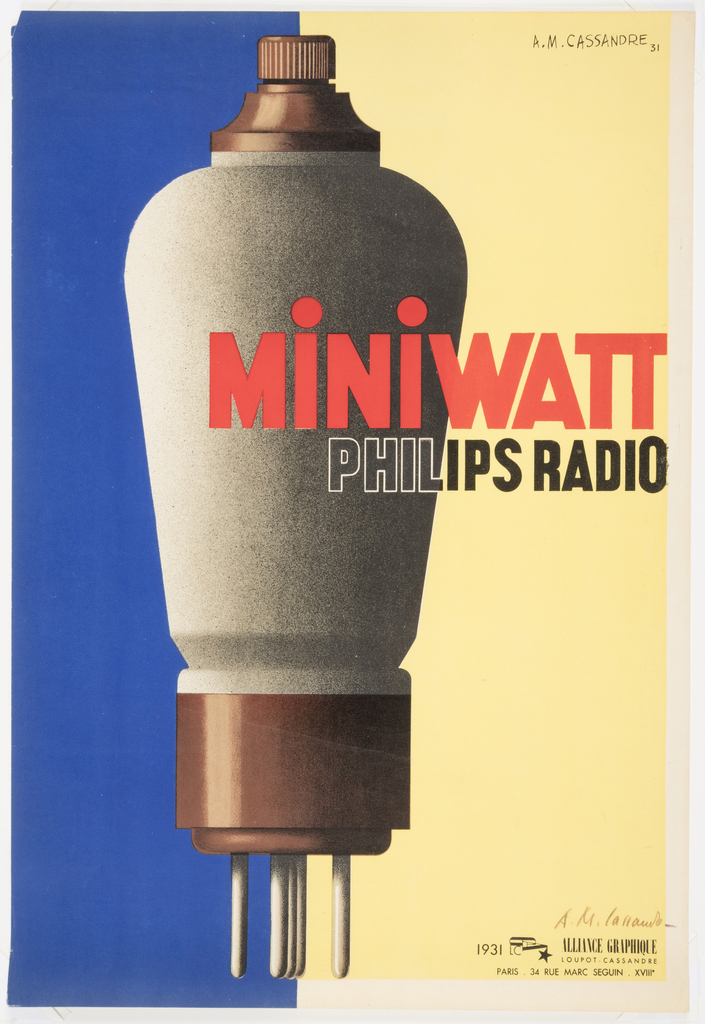
Image features a poaster with blue and yellow background. In the foreground, an image of a Philips Miniwatt Type E444 diode-tetrode radio value lamp, in shades or grey and brown. "MiNiWATT" is printed in red, while "PHILIPS RADIO" is rendered in solid black letters, outlined in white. Please scroll down to read the blog post about this object.
“i’s” or “eyes”
When legendary French graphic designer A.M. Cassandre was hired in 1931 to produce this poster for the Dutch light bulb and radio tube manufacturer Philips, he was at the high point of his career. Together with fellow poster designer Charles Lupton, Cassandre had founded the printing and publishing collective Alliance Graphique in Paris, France.[1] Cassandre...
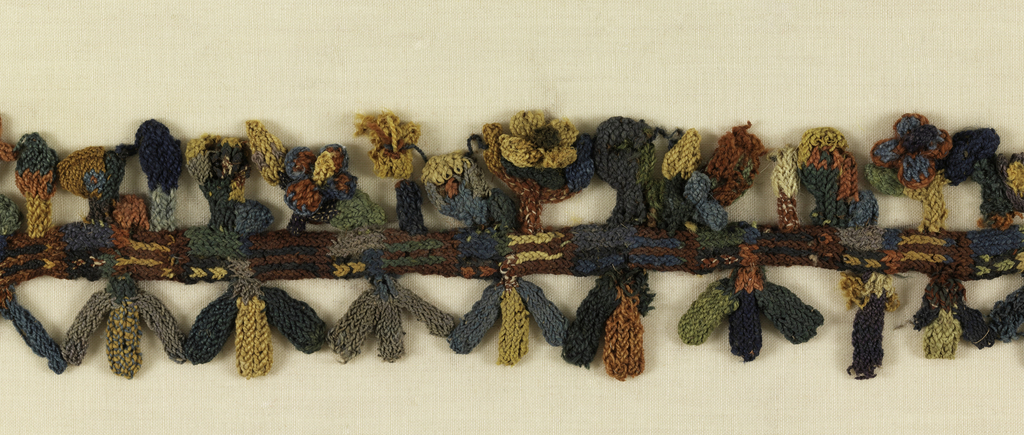
Image feature a colorful wool border depicting birds and flowers. Please scroll down to read the blog post about this object.
The Complexities of Cross Looping
During the period from around 100 B.C. to 400 A.D., Nasca needleworkers from the South Coast of Peru mastered the complex art of three-dimensional cross-looping. A number of colorful and complicated border fragments like this one have been preserved. The few garments that remain intact show that they were used as the outer edging attached...
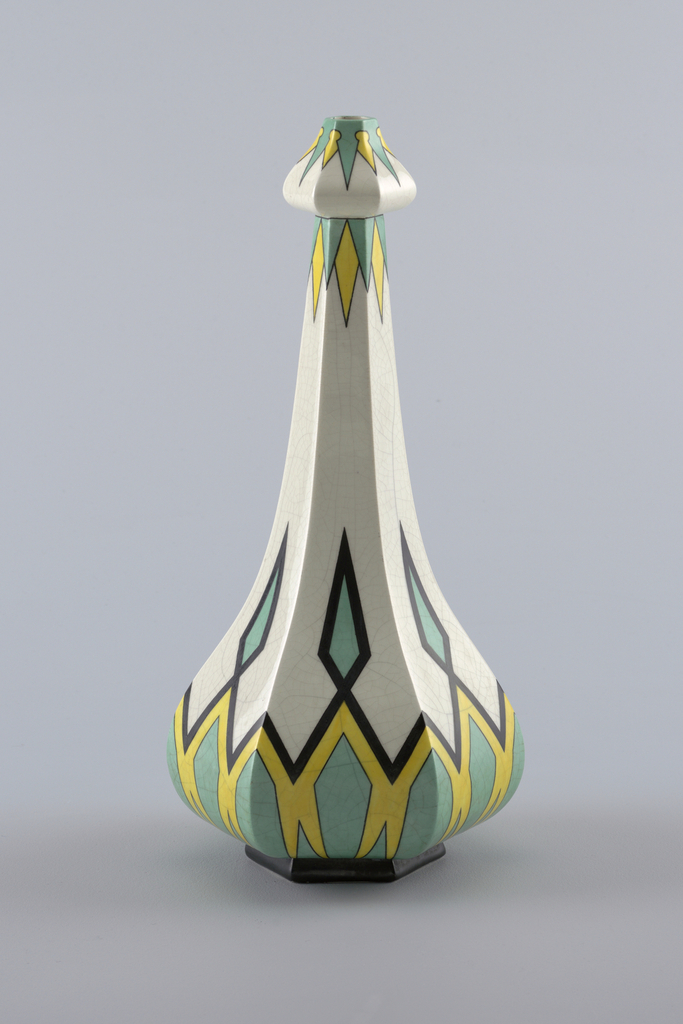
Image features a six-sided bottle-form vase with a bulbous bottom, ascending into a narrow neck, and a rounded arrow like top. The white body is decorated with a symmetrical pattern of diamonds in black, yellow, and mint green. Please scroll down to read the blog post about this object.
Fennia for America
The remarkably graphic, geometric pattern of bright yellow and sea-green crystalline forms that map the surface of this elongated, arrow-like vase appear definitively modern. The origin of this decoration, though, is decidedly not. This vase was made by Arabia, the principal industrial pottery in Finland during the opening decade and a half of the twentieth...
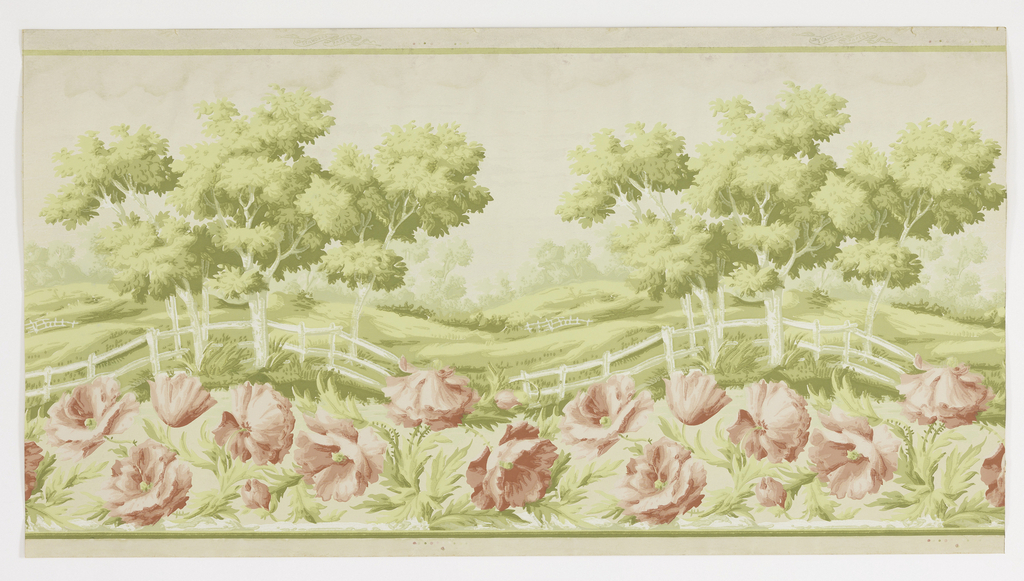
Image features a wallpaper frieze with a bucolic scene of rolling hills, while picket fences, and groves of trees. Please scroll down to read the blog post about this object.
Dining with the Poppies
This is a fun frieze, also known as a wide border, produced in America during the early years of the twentieth century. It captures a bucolic scene of rolling hills, white picket fences, and fields of red poppies. I almost expect to see horses trotting by, or cows grazing. The design has a deep perspective...
Image features a brochure with a diagram of the overall menstrual cycle on the front cover in pink, red, yellow, white, and black against a black background. White numbers representing days of the month are arranged in a circle, and different types of moons appear in white in the four corners. Please scroll down to read the blog post about this object.
Herbert Bayer, Master of the Universe
Herbert Bayer is known for his work as a student and teacher at the Bauhaus, the famous German art school that integrated art, design, and daily life. During Bayer’s formative years at the Bauhaus (1921–1928), he helped create the modern discipline of graphic design by using photography, type, and geometric systems to promote products and...
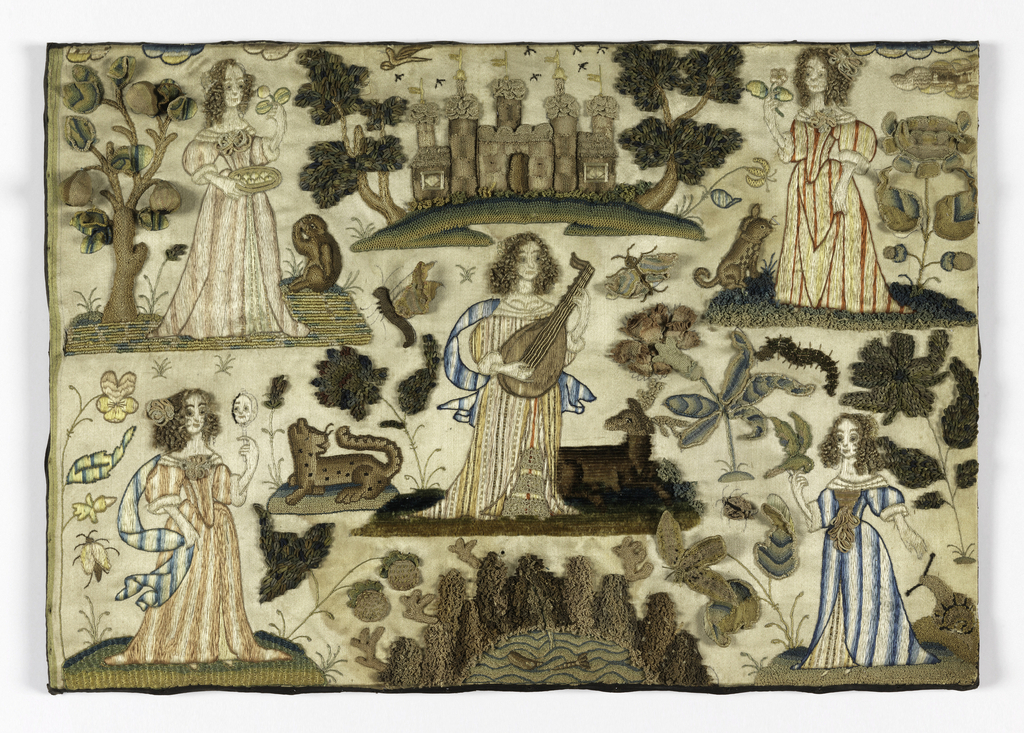
Image features embroidered picture showing five women representing "The Five Senses" with their attributes. Hearing, playing a lute, is in the center, Smell is upper right, Touch is lower right, Taste is upper left, and Sight is lower left. Please scroll down to read the blog post about this object.
Raising the Bar for Intricate Needlework
Author: Katherine Diuguid The wealth of needlework techniques on display in 17th century English raised-work embroideries is a reminder that these pictures functioned as samplers, in which amateur embroiderers would test out different techniques as they progressed in their needlework skills. Whether depicting Biblical or mythological characters, female figures rendered in contemporary dress often enjoyed...