Made in America In-Gallery Resources
The following resources have been designed to support your visit to the exhibition.
Resources for the Made in America exhibition include a sensory map, large print labels, object descriptions, and audio content by Christopher Payne (found below in Exhibition Sections).
Visit Accessibility at Cooper Hewitt to learn more about general accessibility at the museum.
What to Expect
Made in America consists of five galleries on the second floor of Cooper Hewitt. This exhibition primarily includes photography of American factories. There is a video gallery showcasing Payne’s work with multiple factories.
There is seating with armrests throughout the exhibition. Refer to the Visitor Guide for specific locations of the seating. Portable gallery stools are available on the second floor by the elevator. The exhibition is wheelchair accessible.
Large Print Labels
A screen-reader accessible Large Print version of the exhibition labels is available digitally.
You can borrow a printed version of the Large Print labels at the museum. The Large Print label booklet is available to the right of the exhibition’s introductory text.
audio by Christopher payne
Hear more from the photographer. Listen to a playlist of recordings by Christopher Payne describing select exhibition photographs. The recordings are organized by exhibition section below. You can also download the Bloomberg Connects app or visit BloombergConnects.org to access the recordings.
Exhibition Sections
Some small-scale manufacturers still rely on traditional processes to craft largely handmade items, such as pinball machines, felt hats, and fine musical instruments. Regardless of the differences in the products they’re creating, they share a commitment to craftsmanship. These photographs deconstruct familiar objects into their unseen component parts and processes.
Skilled makers wielding hand tools and shaping raw, often messy, materials lead the production in most of these factories. The repetitive nature of factory work means that Payne can wait for what he calls the “moment of peak elegance” in the choreography of production. His images reveal the many individual acts of skill, passion, and technical savvy that contribute to a beautifully made object.
Access Large Print Labels for this section.
Hear from Christopher Payne about select works in this gallery.
2. Lindsey Kiene cutting leather panels to make an NFL Football, 2024
Getting to visit the Wilson Football Factory in Ada, Ohio, where Wilson has been manufacturing the official NFL game ball since 1955, was something that had been on my bucket list for a long time. Here, Wilson worker Lindsay Kiene cuts leaf shaped panels that are tapered at both ends. They will be sewn together to make the iconic oblong shape of the football, a key feature that reduces the ball’s wake and drag. The machine here is a die cutter, basically a giant cookie cutter. What I liked about this scene was that the shape of the football is immediately recognizable and the process is easy to understand. You can see where the panels have been cut out of the leather and then you see them in her hand as well as the metal dye or pattern. I thought I had nailed the shot, but when I showed it to the editor, she suggested I pull back to reveal more of the leather hide, adding another layer of understanding to the picture. The second version, which you see here, proves superior and reminded me that no matter how well I think I know my subject or what the picture should be, there is always a different point of view to consider.
3. Peter Nelson shaping a cymbal on a lathe, 2024
Lathing is the process of shading small amounts of metal from the surface of the symbol, allowing for precise control over its sound and tone. By removing material from specific surface areas, the lathing process can alter each cymbal’s pitch, sustain, and overall character. It’s a key part of what gives each cymbal its unique sonic signature. Zildjian is the largest cymbal and drumstick maker in the world. The company was founded in Constantinople in 1623 by Avedis Zildjian, an Armenian, and is now based in Norwell, Massachusetts. Zildjian is the oldest manufacturer of musical instruments in the world, as well as one of the oldest continuously operating companies in the world. I was only given a few hours at the factory, but instead of rushing and trying to make a few pictures, I decided to focus on one image that would show a pivotal step in the manufacturing process and one where the cymbal is recognizable as a musical instrument. As soon as I walked into the lathing area and I saw this man with his hair in a ponytail and wearing a denim shirt, I knew I had found my subject. He was a veteran employee and had been doing this for decades and he moved skillfully using his entire body to shape the cymbal. Once I set up my lighting and camera, all I had to do was watch him work. To the right of this picture is another musical instrument, a trumpet.
4. Trumpet bells before being shaped on a lathe, 2024
These trumpets are in the early stages of fabrication at the Vincent Bach Factory in Elkhart, Indiana. Each one started out as a single fan-shaped flat piece of brass that was stamped, beaten, and rounded into a tube. If you look closely in some of them, you can see a seam where the two edges meet and have been welded together. A skilled craftsman will continue to refine the shape of the tube, pounding it with a hammer, and eventually spinning it on a lathe, like what you saw with the previous cymbal picture, until the familiar rounded bell shape of the trumpet is achieved. I made a lot of other pictures at the factory, but I’m partial to this one because the trumpets look more like delicate organic flowers instead of the polished brass instruments that they will become. They radiate an almost iridescent glow, changing colors as if made of glass. Seeing them at this early stage, one appreciates the artisanal craftsmanship that goes into each instrument and the fact that no two instruments are alike.
5. General Pencil Company
General Pencil is a six-generation family-owned company founded in 1889 in Jersey City, New Jersey. They’re one of two pencil companies remaining in the United States. It took me five years to win the trust of the owners. But as with my other long-term projects like Steinway Piano and the New York Times printing plant, once I was granted access, I could pretty much come and go as I pleased. In the basement, where raw ingredients are mixed to make charcoal sticks and graphite pencil cores, there were only shades of gray and black. Here in this cramped dirty space, the darkness created a moody ambience. In the picture on the left, the employee emptying the container of graphite cores is illuminated by a single overhead light, but everything behind him fades to black as if he’s on a stage. Other parts of the factory were punctuated by bursts of color. The first pictures I made at General Pencil included more of the interior space, which was filled with vintage machinery and smelled more like an artist studio than a factory. It was fascinating, but I realized the cluttered environment was visually distracting and that I needed to focus only on the pencils. For this reason, I kept the shots tight, often shooting from above, looking straight down, as in the picture of the red pencils drying on the conveyor after being painted, and the one to the right of that of the tipping machine, where erasers and ferrules are attached to the tips of yellow pencils. Here, I use the repetition of the pencils as a compositional grid. The straight down approach flattens the subject and helps make it easier to understand what’s going on. Over the course of a couple of years, I made several dozen trips to the factory. Sometimes I nailed the shot on the first try. Other times, I would return weeks or maybe months later, redoing the picture until I was satisfied. Often, I would time my visits to coincide with the production of a particular color, like the blue you see in the picture on the far right. I had already photographed the spaghetti-like pastel cores being laid in these grooved wood trays a couple of times. First in yellow and then in red, but I felt blue would be better, and it was a color I had not yet photographed, the missing piece of the puzzle. Notice the woman’s fingers. Every week, this employee would match the color of her nails and shirt to that of the pastels in production.
6. Crucible pouring for plate casting, 2024
In this picture, workers at the O.S. Kelly Foundry in Springfield, Ohio pour molten iron from a furnace into a crucible from which it will then be poured into sand molds to create the plates. In a piano, a cast iron plate provides the necessary strength for the frame to withstand up to 23 tons of string tension. Without it, the piano would collapse in on itself. The plates are cast late at night so that they have time to cool before being removed from the molds during the following day. I made this picture around 1:00 A.M. and it is a long exposure, probably four seconds to render the sparks as continuous streams of light and the crucible as an exploding pot of gold. Since I was using four inch by five inch sheets of film, I didn’t know what the outcome would look like until I returned home and had the negatives developed. But as I had hoped, the scene felt as hot and dangerous as it was in reality with a shower of sparks set against the dark murky background.
7. Gwendolyn Folk inserts lead weights into the keys to ensure balanced action, 2016
Of all the departments I visited at Steinway, key balancing provided the most unexpected surprise, that “aha, so that’s how they do it” moment. Today, a lot of operations have been automated at Steinway, all for the best, typically woodworking steps that involve the piano case when it is still considered a piece of furniture. But any step that affects the musicality of the instrument is still done by hand, especially key balancing, a small but critical moment in the hidden choreography of production. Key balancing involves the insertion of lead weights into the keys to ensure even responsiveness of touch across the keyboard. That means when you press a key in the upper register of the keyboard, it will feel the same as one in the lower register. It’s a subtle operation that requires an intuitive hands-on approach honed by years of experience. Gwendolyn Folk has been doing this for 31 years, and you can see her at work in the video we made in the other room.
8. Model D rim press, 2016
To create the distinctive shape of a Steinway grand piano, up to 17 laminates of 3/16th inch hard rock maple are glued together and bent around a press like this. The wood stays in the press overnight and emerges as a continuous one piece case with an integrated inner and outer rim. Steinway patented this method in 1880 and it has been the industry standard ever since. In this picture, the wood is wrapped against the right side of the press and heavy blocks are added to create a kind of sandwich with the wood in the middle. The rounded metal straps and the pipes with screws are part of a clamping mechanism to keep everything in place, ensuring that the wood retains the shape of the familiar S curve. Of all the places and things that I’ve photographed over the years, I probably spent more time in the rim bending room at Steinway than anywhere else. Here in the basement of the factory, some of the finest pianos in the world are born, and I found the process of transforming ordinary strips of wood into the iconic shape of a piano deeply moving. While my large format view camera, the old-fashioned kind that uses 4″ X 5″ sheets of film where I disappear under a dark cloth, was well suited to the slow meditative pace of much of the rest of the factory, it was, in hindsight, probably not the right tool to capture this process. The workers had about 20 minutes to wrap the wood around the press before the glue set up, and there was no slowing down or redoing while they waited for me to get the perfect shot. After intense activity in the morning, the room was usually quiet in the afternoon, and it was then that I could make pictures like this of the presses on their own without people. I marveled at the brilliant design and construction, virtually unchanged since the 19th century. And to me, they were as beautiful as the pianos they created.
9. Piano Rims in Rim Conditioning Room, 2016
This is a view looking through hard rock maple piano rims in the rim conditioning room at the Steinway and Sons Piano Factory in Astoria, Queens, New York. After the rims are shaped and removed from presses, they are chalk-dated and stored upright in this room where they spend several months to reduce moisture content. The room’s temperature and humidity are set at a precise level and are monitored continuously. What’s not evident in this picture is that this room is extremely hot, like a sauna. I first toured the Steinway Factory in 2002, while still working as an architect. And for many years, I kept thinking about this view. After my father and grandmother passed away, both were pianists, my memories of the factory took on a more profound spiritual importance and I felt an obligation to return to take pictures of the instrument so deeply connected to my family. This was the first picture I made at the factory, kicking off a personal project that would take several years. The workers, who didn’t know me yet, must have thought I was crazy because I asked them to keep moving the rims until they lined up perfectly, with just enough space in between each one so that my strobe lighting, bounced off the ceiling and wall, would find its way into the rims and make them look as if they were glowing. To accentuate the perspective, I had larger pianos placed in front and smaller ones in the back. Not long after I finished the project, Steinway started placing braces inside the rims to keep the sides straight during the conditioning process. It was a technological improvement for sure, but it meant that a view like this no longer exists, and I feel lucky to have made this picture when I did. Especially since it took me almost nine years to return to the factory after that initial visit. If there’s one thing I have learned over the years photographing factories or anything for that matter, it’s that nothing stays the same. Manufacturing processes evolve, products are discontinued, people retire, and factories open and close. If you see something that captures your imagination, don’t wait.
10. Oscar statuettes
The Oscar statuette is probably the most iconic thing I’ve ever photographed. In 2022, I was commissioned by CNN to follow the making of the statuettes from start to finish. And four pictures from this series are included in this exhibition. Over the past century, the design of the statute has varied. To create the current version, the Academy supplied the manufacturer, United Art Projects, with an original 1928 statue and a more modern version. UAP 3D scanned both, and came up with the current model that is truer to the art deco original and cast once again in bronze. Each statuette is 13 and a half inches tall and weighs eight and a half pounds, about the same as a gallon of milk. The manufacturing process begins with a rubber mold that is based on the 3D printed master reference model. From this rubber mold, wax figurines are made, one for each Oscar that will be presented at the Academy Awards. A tough ceramic shell is built up around the wax figures by dipping them in a vat of silica, which is what you see in the top left photo. The shell, which contains three statuettes, is placed in an oven to melt the wax. This is known as the traditional lost wax casting method. Then molten bronze is poured into the cavity where the wax used to be, as in the bottom right picture. After the bronze cools overnight, the ceramic shell is broken open, revealing the bronze statuettes, as seen in the top right picture. The rough statuettes are inspected and sent to the finishing department, where they’re refined and polished. Everything has to be precise, because any imperfections will be amplified when they are plated in gold. Each statuette is triple plated, dipped first in molten copper, as you see in the bottom left picture, then nickel, and finally gold. There are no factory second statuettes or free samples, and each of the roughly 60 statuettes that UAP makes annually are accounted for, kept in a locked room under continuous video surveillance. The statue fits perfectly in the hand, and you can’t help but feel the allure of its mystique. Truth be told, when I first held one, I felt like Gollum in Lord of the Rings. In a perfect world, if I could have taken one home, I probably would’ve chosen the nickel-plated version, which is sparkling silver. To me, it was as beautiful as the gold version, but more precious because it is never meant to be seen by the public.
Some of the country’s newest factories house millions of square feet under a single roof. In them, objects of immense scale are manufactured. The human figure appears tiny beside the monumental forms of jumbo jets, container ships, and wind turbines.
But most manufacturing happens at human scale—at workstations with tools that are within arm’s reach. Huge rockets, ships, and submarines are assembled piece by piece from smaller sections. Payne searches factories to find a connection between the individual worker and the finished product. He focuses on an essential part of the process, a purposefully designed machine, or a craftsman immersed in the work. The resulting images reveal the personal pride workers feel in contributing to a colossal whole.
Access Large Print Labels for this section.
Hear from Christopher Payne about select works in this gallery.
11. Christina Akers prepping a GE90 jet engine for testing, 2023
For an industrial photographer, few things are as beautiful as jet engines, and I never tire of photographing them. I photographed engines of various sizes, but for this exhibition, we wanted to share something really big and powerful, like the GE90 engine used on the Boeing 777. To make this picture, I traveled to GE’s test facility in Peebles, Ohio, a vast isolated space where powerful and loud jet engines are tested and run for long durations without disturbing the local population. Seeing a jet engine up close is so different from seeing it from the window of a plane. I couldn’t believe how big it is, and I’ve seen a lot of engines. In fact, the GE90 is one of the largest commercial engines in the world and has a diameter roughly equivalent to two SUVs placed side by side. The technician at work here is great for giving a sense of scale. When engines like this are being worked on, their cowling or cover is removed, so you can see everything like a car with its hood up. It’s a wonderful opportunity to appreciate the complexity of these incredible machines. They are like giant sculptures that actually work, the perfect balance of form and function.
12. Sanding infused fiberglass inside a wind turbine blade, 2022
Climate change and clean energy are big issues these days, and wind farms are becoming more ubiquitous in the American landscape. If that wasn’t reason enough to visit this factory, I knew I would find something unlike anything I had photographed before. The blades on wind turbine towers are enormous, between 200 to 300 feet long on average. To make a blade, long sheets of fiberglass are rolled out like a carpet inside a mold and infused with resin that hardens the fiberglass into a strong, lightweight shell. The semicircular half you see here will be attached to its other half to create the complete blade.There was no way to capture the entire length of the blade, so I chose to photograph it head-on in section. The length stretches away down the middle of the photograph until it disappears into the background. Together with the three workers, it gives a sense of scale, and we see how it’s made and what it’s made of. Amazingly, much of the work is done by hand, with workers like these using palm sanders to make sure everything is smooth and perfect. You can see the numerous yellow bolts on the cross section that will help secure it to the nacelle. That’s the housing on top of the tower that contains the generating equipment that converts the rotational energy of the blade into electricity.
13. Tremonde Gaines polishing a Bridgestone 59/80R63 tire during final inspection, 2025
I am constantly on the lookout for factories and processes that I haven’t photographed. YouTube is a great resource. And when I found an old video of tires being made, I immediately added them to my to do list. The manufacturing process is fairly simple. Rubber and other ingredients are mixed together into a dough, and that dough is placed in a mold that contains the tread pattern. After heat and pressure are applied, the mixture expands and takes the shape of the mold. And voila, out pops a finished tire, much like batter is poured into a waffle iron to make waffles. So when the New York Times magazine asked if I had any ideas for their kids section centered around the theme of things that are big, it took me about 30 seconds to reply and suggest giant tires. These tires look and feel like the ones on your car, but they’re much, much larger. More than 13 feet in diameter, and they are used on mining trucks the size of a house to carry 400 tons of rock. Tires have been around for a long time, so I figured getting access to one of these factories would be easy. But boy, was I wrong. The manufacturing process is highly proprietary, much like a secret cooking recipe. While there are dozens of tire companies, only three make tires this large. And only one, Bridgestone, accepted our request. Despite the restrictions on what I was allowed to photograph, I was able to make enough pictures for our story, including this one of a technician standing inside a giant tire to polish it. It looks almost unreal, as if the guy has been shrunk to fit inside the tire. Originally, he was wearing a black shirt, but with just minutes to spare before the photo shoot ended, I asked him to put on a red one. Sometimes the smallest changes, like this burst of color, really make the image pop.
14. and 15. An R1S SUV “top hat” is lowered onto the “skateboard” platform 2022, and Jaylin Jones decking a rear brake caliper on the frame of an F-150 Lightning, 2022
Automobile assembly plants are the size of multiple football fields and seem to go on forever, requiring a golf cart to get around. There’s a dizzying amount of activity happening, and beautiful pictures seem to beckon everywhere. It’s impossible to capture everything, so I try to find moments of clarity in the visual chaos, perhaps a key step in production or a beautiful detail. At the BYD Electric Bus Factory in Lancaster, California, the bus frame provided a literal framework upon which I could let the action of the welders unfold, as if they were actors on a stage set. Here again, I used a long exposure, probably a second, to render the sparks as continuous showers of light. The picture to the right from Rivian in Normal, Illinois, stood out because it’s where the vehicle finally comes together and begins to look like a car. It’s one of the quintessential defining steps in automobile mass production. And if you watch a video from 100 years ago of Model Ts being made, you’ll see pretty much the same thing happening. The Rivian picture shows the marriage station where the top hat, that is the styled upper portion of the vehicle that is recognizable as a car, is lowered or married onto the skateboard. The skateboard contains the frame, battery, drive units, suspension, thermal system, and lots else. Probably 90% of the vehicle’s technology is in the skateboard. Several top hats can share the same skateboard. The biggest challenge with car factories is that production lines are always moving. They can’t be stopped or slowed because everything is connected. Fortunately, here at this station, there was a brief pause before the top hat was lowered onto the skateboard. Nothing more than a few seconds, but just enough time for me to make this picture. At Ford, to the right of the Rivian picture, a 30-minute lunch break allowed me to insert my camera in the middle of the assembly line for a straight on view of the frames. Sometimes it’s nice to show movement instead of trying to freeze it. In the picture on the far right at Hyundai in Ellabell, Georgia, I used a long exposure to render the frenzy of yellow robotic welding arms as a blur. In this modern factory and others like it, robots are everywhere. Welding car frames like you see here, installing doors and heavy components, painting car bodies, and shuttling parts from station to station.
16. Aircraft
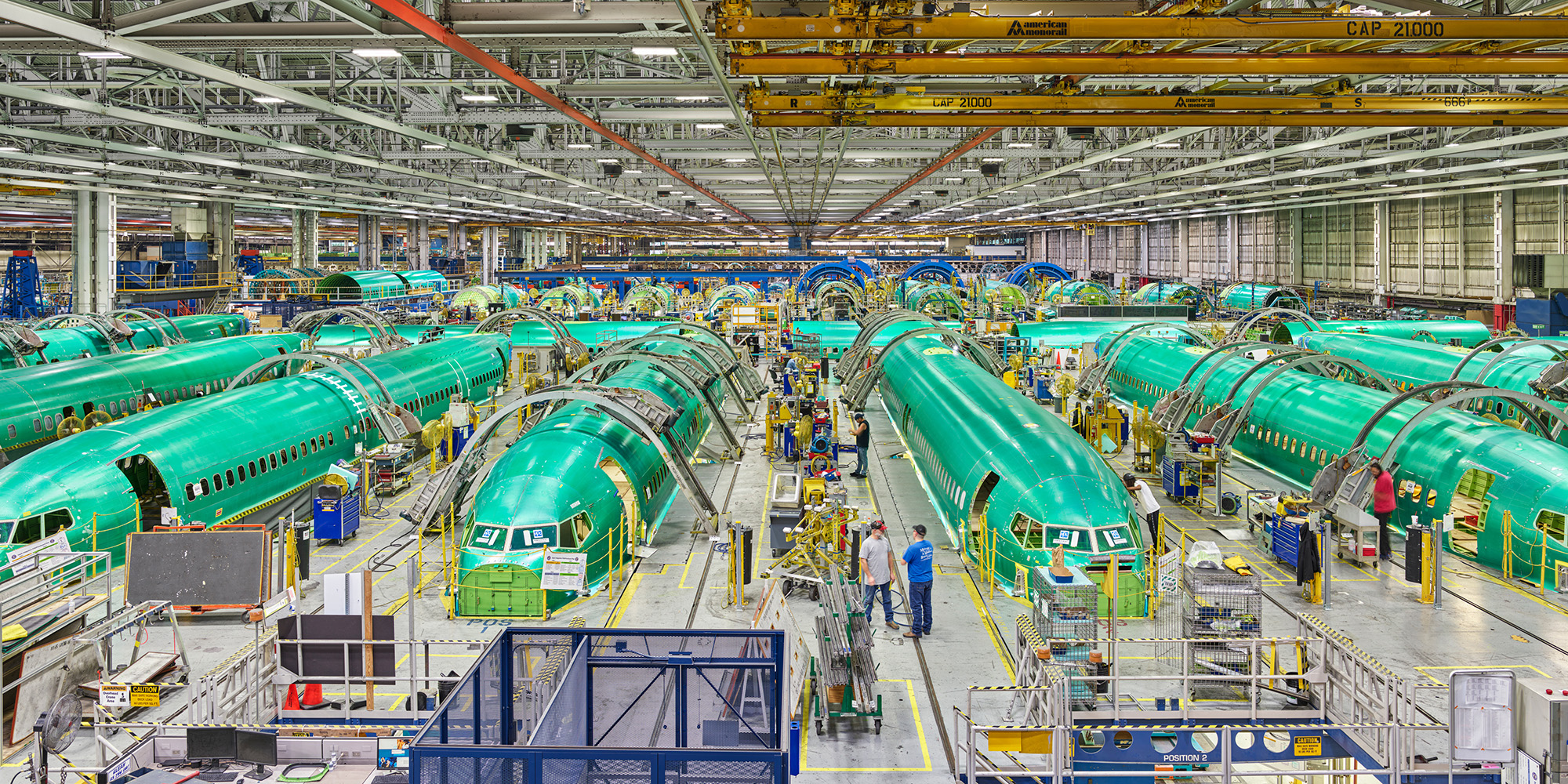
On the far left is one of my favorite pictures of green Boeing 737 fuselages being assembled at spirit aero systems in Wichita, Kansas. The green paint is protective primer, but it makes the fuselages, the main body of an aircraft look like toys. Going to this factory felt like a pilgrimage because it is a historic site. During World War II, it turned out bombers for the war effort and it has been making large planes ever since. It was reassuring to see it still being used for its original purpose, still active as it was over 80 years ago. This picture is actually a composite of two frames stitched together, one for the left and one for the right, using what’s called a technical camera. In a typical camera, the lens and sensor are fixed, but in a technical camera, the sensor can move independently of the lens, up or down or side to side, or a combination of both. Like its large format film predecessors, the kind where the photographer disappears under a dark cloth, technical cameras are cumbersome and slow, but they yield images of incredible richness and detail. In 2016, I received the commission of a lifetime to follow the final assembly of an Airbus A320 plane from start to finish for the New York Times magazine. I made eight trips to Mobile, Alabama to the assembly plant, as well as a couple of trips to Pratt and Whitney in Connecticut where the planes jet engines were being made. For the exhibition, we chose to include the very first picture I made in Mobile of our plane’s fuselage being unloaded from a ship that had come from France where the fuselage is made. I didn’t have as much time as I would have liked at Airbus, so when I was working on my Made America book, I made a point of photographing additional airplane factories. As the picture from Spirit Aerosystem shows, airplane factories are enormous and you feel as if you’ve entered a world suited more for giants than humans. Yet much of the work still happens at human scale. The arches around the green fuselages are actually tracks upon which workers move up and down to fasten rivets. When they’re on top of the fuselage, the workers are lying face down. Sometimes it’s the plane that rotates to accommodate the worker, as in the picture on the right, where the front of a Boeing 767 is turned upwards to meet the seated technician, who is locating fastener holes on what will be the top of the cockpit. The last photo on the right shows a Boeing 787 Dreamlighter mid-body in section, as if cut in half, before it is attached to the front and rear sections of the plane. I love this kind of view because it strikes the perfect balance between beauty and information. We see parts that are normally hidden, the framing, wiring, insulation, ventilation systems, and the luggage compartment, all contained within an almost perfect circle. It reminds me of a cutaway drawing that teaches you how something works by revealing it in a new and unexpected way.
17. General Dynamics
Large container ships play an almost incalculable role in the modern economy, responsible for delivering the vast majority of the products we buy. They make up a circulatory system that carries more than 90% of all traded goods. In 2019, I went to San Diego to General Dynamics NASSCO to photograph the making of a container ship for The New York Times. Almost everything at this shipyard is enormous, and it was both thrilling and overwhelming to be in an outdoor factory the size of a small city. The work is spread out over many acres, requiring a golf cart to get around. And to the untrained eye, it is difficult to tell what’s happening and what’s being made, and whether it’s right side up or upside down. The creative control I’m used to having where I can move things around was not possible here, and I felt more like an observer than an artist. Despite the immensity of the shipyard and the size of the ships, much of the work happens at human scale. The ship isn’t put together all at once, but rather piece by piece in blocks, like you see in the picture on the right. Steel plates are cut, welded, and shaped into the skeleton of the ship. Each block is painted and fitted with equipment by hand, notice the ladders and pipes in the picture, before being assembled into bigger, grand blocks. Ultimately, all these blocks come together to make a ship. I was able to leverage the success of the container ship story to gain access to another General Dynamics shipyard, Electric Boat in Groton, Connecticut, where they make nuclear submarines for the US Navy. Probably 90% of the pictures I wanted to make at Electric Boat exist only in my mind because almost everything I saw, understandably, was classified. For instance, I could take pictures of the smooth, rounded front bow of the submarine, but I was not permitted to photograph its propellers and propulsion system in the stern. Cell phones were not allowed and every picture I made was carefully reviewed before I left the premises. Images not approved were deleted on the spot. The highlight of Electric Boat and the very last picture I made was this photograph of a submarine hatch that you see on the left. With its gears and intricate workings, it looks like a Swiss watch, but it is also rugged, built to withstand thousands of pounds of deep sea pressure. To me, this picture distills the complexity of a 377-foot-long vessel into one compact composition and humanizes something that is intentionally meant to be secret and unknowable. It is also a small but welcome consolation for all the pictures I wasn’t able to make.
Some of Payne’s photographs seem to capture a vanishing world. In fact, some of the textile mills he has photographed have since closed. With global supply chains quickly shifting because of environmental and other geopolitical factors, many other factories are under construction or newly opened, particularly in the renewable energy, microchip, and robotics sectors.
Today’s technology-driven factories contain some of the most sophisticated systems and machines in the world. Many look more like the clean room of a hospital or a laboratory than like a traditional industrial factory floor. Despite that, even today’s most fully automated spaces continue to require the human hand and eye, with people monitoring and choreographing the collaborative work of hand and machine.
Access Large Print Labels for this section.
Hear from Christopher Payne about select works in this gallery.
18. GlobalFoundries
In this room, you’ll see two pictures from GlobalFoundries Malta Fab or Fabrication Facility, one of the largest microchip manufacturing facilities in the U.S. Despite their small size, microchips play an essential role in today’s technology driven world. They are the brains behind every modern electronic device, like our phones, computers, cars, and smart devices. In fact, they are so important that their manufacture has become a matter of national security. The first photo, as you enter the room, was made in the cleanroom, where microchips are made. The first time I entered a cleanroom, I felt like I had stepped into the future. It is a cool, sterile, brightly lit, windowless space with smooth non-porous walls, floors, and ceilings made of stainless steel or specialized plastics. A fab cleanroom is thousands of times cleaner than a hospital operating room to prevent tiny dust particles from ruining the chips. It is an extremely controlled environment with separate gowning areas for staff, who wear full protective bunny suits and air locks to maintain pressure differentials. In my case, all my equipment had to be wiped down with alcohol. And I couldn’t bring in anything that was made of cloth or soft material that might shed fibers. One of the biggest challenges of photographing at GlobalFoundries was capturing the wafers in production, since the manufacturing process is automated and hidden from view, taking place inside machines that cost upwards of $250 million apiece and are as large as a school bus. That said, we were allowed to open up one machine, a wafer sorter. And I was able to place my camera inside and have the gowned and masked technician inspect the wafers to create a dramatic, intimate scene, humanizing a subject that might otherwise seem incomprehensible. The other picture from GlobalFoundries on the long wall to the right and the center was made in the sub-fabrication floor below the cleanroom. At first, I was disappointed because the subfab seemed generic like any other mechanical space. Then I looked up and saw a maze of pipes and tubes feeding the main floor, revealing the Fab in all its complexity in a way not possible in the cleanroom, where everything is enclosed. To me, this picture is the perfect balance of order and chaos, yet still ambiguous enough to inspire imagination and awe.
19. Lydia Fox inspecting a wafer sorter, 2022
Glass has been manufactured since the earliest days of human civilization, and it remains one of the most important materials in science. From tiny strands of fiber optic cables to bendable screens on cell phones, there is practically nothing it can’t do. It is the only material that can be infinitely recycled. The making of glass is fascinating, but its unique properties make it one of the most challenging subjects to photograph. Of all the pictures I’ve made of glass, this one is probably my favorite. The glass you see here is called high purity fuse silica, or HPFS. The material’s purity and strength make it ideal for lenses, beam splitters, and other optical devices, as well as windows for spacecraft and submarines. In real world applications, you can see straight through it as if it’s not there. But during the manufacturing process, before it’s polished, its surface is slightly frosted. When I came upon this technician hovering over a bool of HPFS, I was ecstatic because I had never seen glass like this before. It was round, a lucky, beautiful byproduct of the manufacturing process. We lit the glass from the side so that it glowed like a block of ice, something that would not have been possible if the glass was polished clear. I love this picture too because it shows that behind even the most advanced technologies, the human hand and eye still abound.
20. Stargate, a 3D metal printer, prints a Terran 1 rocket, 2022 and Quantum computer, 2017
I made this picture of a quantum computer at IBM’s Thomas J. Watson Research Center in Yorktown Heights, New York. As the global headquarters of IBM Research, the facility is home to over 1,500 scientists, engineers and designers inventing what’s next in computing. Many of IBM’s most noticeable technical breakthroughs in quantum computing, artificial intelligence and semiconductors have taken place on this historic campus. While traditional computers rely on bits, that is zeros and ones, to store and process data, quantum computers process data differently by using quantum bits, or qubits. A qubit can behave like a bit and store either a zero or a one, but it can also be a combination of a zero and a one at the same time. Problems that might take a traditional computer thousands of years to solve might be solved in a matter of minutes or hours with a quantum computer. These supercomputers require extremely low temperatures, near absolute zero or minus 460 degrees Fahrenheit, to operate effectively. They are suspended from the ceiling to minimize vibrations, and often resemble chandeliers in all their intricate beauty. This photograph provides a view looking up at the computer, the pristine wires, discs and coils shining, reflecting light off each other. Typically, the chandelier would be enclosed in a cylindrical case, but here we see it uncovered while it’s being worked on in the lab. This picture is from 2017 and the computer is outdated by today’s standards, but I feel this version has a jewel-like handcrafted quality that the newer, more standardized models lack.
21. Axiom Space conducting an endurance test on the Axiom Extravehicular Mobility Unit (AxEMU), 2025
For decades, American space exploration was solely the purview of NASA, but now, private corporations are getting involved as space exploration becomes increasingly commercialized. I knew I wanted to include at least one aerospace image in the show, and the first thing that came to mind was Axiom Space’s new spacesuit, which will enable astronauts to explore the moon for the first time in over 50 years as part of the Artemis III mission to the lunar south pole. Whenever I photograph anything with cutting edge technology, there are concerns about not revealing proprietary intellectual property. I couldn’t photograph the inside of the suit or peel back the layers of fabric to show how it’s made, and yet I didn’t want to photograph it as a static object, as it’s been shown in media announcements. So we decided to show one of the many ways the suit is tested on Earth to make sure it functions perfectly in space. After liftoff, there is no room for error. I like the playfulness of this scene, of seeing something so high tech and futuristic being put through mundane tests, like a technician walking on a treadmill. Up close, the fabric looks and feels almost familiar, like the kind of cloth you’d find on a high-performance outdoor gear. But when you see the helmet, gloves, and all the special fittings, you realize it’s one of a kind, designed and crafted for the most extreme extraterrestrial conditions. You’ll also notice a harness attached to the suit at the back of the neck. That’s no mistake. On Earth, the suit weighs too much for someone to move around in it freely.
22. Dave Lin installing a motor controller into the arm of Apollo 1, a humanoid robot, 2025
Most of the things I’ve photographed are evolving iterations of traditional products like appliances, planes, and cars, which is why it’s so exciting to be able to document a completely new technology, humanoid robots. Industrial robots are already commonplace in factories, automating tasks where the work is dirty, dangerous, demanding, and repetitive, but humanoid robots are still in development.In recent videos, you can see humanoid robots performing amazing feats, running, jumping, lifting heavy objects, even just walking around in a naturalistic way that is uncanny. I saw a bit of this at Apptronik, one of a handful of companies leading in the development of humanoid robots in the US. But most of the time, I saw technicians tinkering with these mechanical creations, taking them apart, rebuilding them, and teaching them to learn using AI. It’s a lot of trial and error. So for this picture, I wanted to emphasize the intimate quality of what it’s really like behind the scenes. Here, a worker carefully tends to the hand of a sleek humanoid robot with wired joints. Robots may someday take over the world, but for now, they still need us.
Factories can be vast and filled with dizzying amounts of activity. When entering these spaces, Payne tries to identify a beautiful detail that distills the essence of the work being performed. How does it work? What is the most essential part of the process? How is it unique?
Payne’s photographs are meticulously planned rather than spontaneous. To achieve a compelling combination of scale, form, color, and composition, he sometimes waits weeks or months until a critical stage in the manufacturing process is reached and ready to be captured.
Many of the visual elements of industrial photography arise from foundational concepts of mass production. The core principle of standardized, interchangeable parts results in endless repetition of identical forms. Circular forms abound in such spaces: wheels, drums, rollers, spools, and gears speed the movement of materials around the factory. Even the bright reds, oranges, yellows, and blues used in many factory settings are standardized to improve worker safety.
Access Large Print Labels for this section.
Hear from Christopher Payne about select works in this gallery.
23. Portraits
I love photographing people at work. And for this room, we chose four of my favorite environmental portraits. You’ll notice that the background is dark, which is done on purpose. When possible, I use dramatic lighting to focus on the worker while obscuring the background. It’s a theatrical approach that elevates the subject while lending warmth and intimacy and a practical way to get rid of visual clutter, which is omnipresent in factories. Many photographers I admire, Alfred T. Palmer, Maurice Broomfield, Gordon Parks, and Chris Killip use similar techniques in factory settings. The first image on the left is John Mercado, who was literally immersed in his work, cleaning a giant press of the New York Times printing plant. Once a week, the pressmen have to clean the rollers. It’s a messy job, but they don’t mind because once they’re done, they can go home early. The presses are three stories tall, four, if you count the basement, and it’s impossible to convey their size elegantly in one picture. I could never stand back far enough to capture their entire width or height, but with this picture, I could at least reveal their complexity. Next is Leon Kalajian, who was 82 years old when I photographed him at his workshop in the Garment District in 2018. He had been working in the textile industry for 76 years, starting in his family’s mill in Lebanon as a kid and eventually emigrating to New York in the 1970s to continue the family business. Here, Leon is holding the pattern for a sunburst pleat made of heavy paper, which would be used to add dramatic flare to a gown or skirt. In simple terms, pleating is the process of putting a design of creases into a fabric, a technique that has been used for thousands of years. One of the earliest examples of pleated fabric can be found in Ancient Egypt, where pleats were used to enhance garments of the nobility. I was fascinated by this process and loved pouring through the handmade patterns that filled Leon’s shop, which were as complex as origami and more beautiful than the finished fabrics themselves. But as soon as I met Leon, I knew he needed to be the focus of the picture. He was a master craftsman whose life’s work was fused into his mind, body, and hands. Leon passed away in 2023, but I am grateful to have met him and honor his legacy through this picture.On the rear wall, you’ll see Daniel Anzuris assembling a heavy industrial motor at the Ward Leonard factory in Connecticut. Motors like this used on naval ships have to be rugged and dependable. So at Ward Leonard, they’re made by hand, one at a time. I love finding scenes like this that are colorful and playful with the curly wires, but which look as if they could have happened a century ago and speak to a craftsmanship that is seemingly vanished from the modern workplace.To the right is Gay Burdick tending to an “end destination” sign in a light box that’s still used on older subway cars here in New York. Like the motor assembly picture, I remember being amazed that someone still does this kind of work since most signs are now LED. I made this picture during the pandemic and Gay could have kept her mask on, but with portraits, it’s important to see someone’s face and expression. We scrolled through all the letters and numbers of the subway lines, but the Q stood out because of its round shape and the yellow complimented her purple shirt.
24. Wool being carded for paint rollers, 2012
Carding is a mechanical process that disentangles fibers to produce a continuous web suitable for subsequent processing. This is achieved by passing the fibers between differentially moving rollers embedded with metal pins that break up the clumps and align the individual fibers so that they’re parallel to each other. The process is akin to combing your hair. The pink wool passing through these carders will be used for paint rollers, the kind you’d buy at Home Depot or Lowe’s. I spent several years photographing old textile mills in New England, searching for remnants of a once dominant industry that had been the engine of the American Industrial Revolution in the 19th century. I loved finding old mills like this one, filled with vintage equipment still in operation. It was like stepping back in time. I befriended mill owners who, in addition to opening their doors, would inform me on more than one occasion of a colorful production run, an invaluable tip that transformed a drab monochromatic scene into something photogenic and magical. I had already made the same picture with orange wool at night. It was good, but I felt it could be better. Then one morning, the owner of the mill called and said they were running pink that day and that I should definitely come up. It was a three and a half hour drive and being a New Yorker, I hesitated because I didn’t want to give up my parking spot directly outside my apartment. Looking back, I’m glad I made the right decision. As I was gathering captions for my book, I was sad to learn that several of the textile mills I’d photographed, including this one, had closed, not so much due to competition or lack of business, but because it was time to call it quits. The owners wanted to retire. The challenge with all manufacturing is finding new talent and young people to learn the multitude of vocational trades required to keep production humming, especially when it involves the maintenance of old, obsolete machinery for which there are no new replacement parts. The lack of qualified workers is a common refrain I hear over and over from plant managers. And sometimes I fear the greatest impediment to a resurgence in American manufacturing might not be from abroad, but from within.Next to the pink carders and on the other end of the textile spectrum is a picture that I made in Georgia at Interface, a global manufacturer of commercial flooring. The man in the photo is gathering yarn to be fed into a tufter, which uses a needle to punch yarn through a backing material to create a raised pile resulting in a plush textured surface. Tufting is how most commercial carpets, rugs, and even artificial turf are made. New technologies are often integrated seamlessly into everyday products in ways that are indiscernible and Interface has figured out a way to fuse captured carbon dioxide into the backing of the carpet. Even though the product is high-tech, the manufacturing process still requires the deft touch of the human hand. I remember how thrilled I was when I saw this man standing at the station immersed in his work. He had a great look and fit perfectly in the composition as if the yarn above had parted just for him. The scene felt alive and new, but also rooted in the past, bringing my previous work in textile mills full circle.
25. A four-page-wide continuous web of paper runs through the printing press, 2019
The New York Times printing plant was one of the most challenging places I have ever photographed. It took five years to gain access, and I made dozens of visits over the course of several years, but it never got easier. It was vast, chaotic, and visually overwhelming, and no two papers were ever alike. If there was a particularly colorful press run, I had one chance to get it right. The hallways of the facility were lined with vintage black-and-white photos of the original 43rd Street plant in Times Square, circa 1950. I was inspired by these images but frustrated too, because I knew I could never recreate the days of hot type and lead plates, and often I would leave empty-handed after spending a day in search of an elusive composition. It was thrilling to be inches away from these giant presses, which can crank out 75,000 newspapers an hour, and I was obsessed with this view, of a continuous web of paper running through the press at speeds of up to 2,500 feet per minute. I had been working on variations of this picture for a long time, playing with exposure times and lighting techniques. For the final version, I waited for triple drama, the arts section that comes out once a year in the fall, filled with full-page ads for all the Broadway shows. It’s big and colorful and there’s nothing else like it. The presses generate a ton of vibration, which couldn’t be helped, but I was able to offset the poor existing light by illuminating the paper with my own lights to create evenly-exposed sheets of rainbow colors. Then I used a strobe light to capture fragments of the words and images as they whizzed by. I love this picture, because it shows how photography can record the passage of time and also freeze the constant movement.
26. American flags in production on a rotary screen printer, 2018
Held in the hand, a flag is a fairly simple piece of fabric. But flying in the wind, it represents a nation’s sovereignty, identity, and its most noble ambitions. Founded in 1847 and family-owned for six generations, Annin has a rich history. Their flags have accompanied expeditions to the North and South Poles, were raised by Marines at Iwo Jima in 1945, and flew to the moon with the Apollo astronauts. In addition to the US, Annin produces flags for other countries, states, towns, institutions, companies, families, and even custom designs for those popping the question, “Will you marry me?” This picture shows American flags in production on a rotary screen printer. As white fabric passes underneath the roller coated with blue ink that adds the stars, and then a red roller that adds the stripes, the American flag pattern visibly comes to life. The scale of Annin’s operation is vast, but nothing stands out so clearly as the American flag. Whether seen as a single embroidered star on a field of blue, or a strip of red sewn to white, the final whole is always evident in even the smallest details, a whole greater than the sum of its parts, like our nation itself.
27. Greg Carson installing roof-mounted hardware at the Cab Tilt station, 2025
On the left, we see two motor graders being calibrated. A motor grader is a specialized piece of construction equipment designed for precision grading, surface shaping, and snow removal on roads. These machines are essential to maintaining and constructing roads across diverse terrains and climates. The iconic green and yellow John Deere tractors are synonymous with farming and agriculture, but John Deere also makes a wide range of construction equipment, including motor graders like these in Davenport, Iowa. Before they leave the factory, each motor grader is thoroughly inspected and tested for functional and mechanical quality. Special test stands are used for calibration, and every grader goes through a full range of motions and actions that simulate real world job site conditions. These tractors are massive, but they look like toys within the mammoth factory and surrounding machinery. This ended up being my favorite picture from the series. Next to John Deere is a picture of a driver cab that will become part of a Peterbilt 589 truck. Peterbilt is a leading producer of heavy duty commercial trucks and their 18-wheelers are ubiquitous on the American highway. The 589 is its premium flagship model, a blend of classic retro styling with cutting edge technology. The cab tilt mechanism is designed to facilitate the ergonomic installation of roof-mounted options such as marker lights, air horns, and sun visors. When I saw the cab being tilted, I was immediately reminded of the John Deere picture and knew that they would make a great pair. Side by side, we see these powerful machines in a new and unexpected way, while also learning a little bit about how they’re made.
28. PEEPS Marshmallow Chicks cooling on a conveyor belt before being packaged, 2023
This picture shows an Easter favorite, PEEPS marshmallow chicks, drying on a conveyor before packaging. I had long wanted to photograph the Just Born Factory in Bethlehem, Pennsylvania, because they make a variety of well-known colorful candies, but access was difficult and I had practically given up. Then out of the blue, the company reached out to me, and amazingly at the same time, the New York’s Time Magazine Kids section asked me if I had any ideas for their Easter issue. It was a match made in heaven, and before I knew it, I was inhaling the intoxicating smells of sugar and marshmallow, which overwhelm you when you first walk onto the factory floor. The making of the PEEPS is relatively straightforward. Basically, white marshmallow is squeezed onto a sugar-coated conveyor belt by a proprietary process, and then sent through a sugar shower, which is a burst of compressed air that stirs up the yellow sugar on the conveyor belt, coating every inch of the white marshmallow. What the manufacturing process lacks in complexity, it makes up for in scale. An endless parade of PEEPS marching along the conveyor belt. I knew this was going to be the hero shot of our story, but on the day of the shoot, the main production line was down. Luckily, there was an alternate production line in another part of the factory, though this conveyor was half as wide as the main one, and by that standard, not as impressive. However, it offered something the other did not, this sensuous S-curve, something I’d never seen before. It made for a great picture, much more exciting and unique than I’d hoped for.
1. Mark Tatum assembling a Discovery IP PET/CT scanner, 2024
PET and CT scanners are used in hospitals to detect and monitor a variety of conditions and diseases. Like MRI machines, they resemble a large tube that the patient passes through on a table during the scanning process. At first glance, you might think you’re seeing one scanner, but it’s actually two in a row. I made a few versions of this picture and in the first, I asked the technician to work in the front portal. The shot was good, but not great, and I felt the technician had become the focus instead of the scanner. When I moved into the background, everything clicked. The front scanner now looked massive because he was much smaller and there was a sense of depth because you could see through the portal, but it also gave the illusion of it being one giant machine. I remember wishing that the scanner was more finished with more cool stuff, but you can never control what’s happening on a factory floor and you have to make the best of the situation.
Then I noticed the beautiful patterns of etched lines on the aluminum left by the milling process, where metal had been removed to create a flat mounting surface. These patterns would soon be hidden. By lighting it head on, I was able to make the patterns stand out. And in the end, this machine, the one that I had initially thought was less photogenic, yielded an unexpected and far more interesting picture.
Bollman Hat Company is the oldest hatmaker in the country. Payne has returned to its Adamstown, Pennsylvania, factory many times over the years to capture the unique process of transforming fluffy white wool fiber into exquisitely shaped and colored felt hats.
Access Large Print Labels for this section.
Hear from Christopher Payne about select works in this gallery.
29. Bollman Hat Company
For my editorial commissions, I am typically focused on creating a few great pictures that capture the essence of the work rather than documenting every aspect of it, although I have done a few step-by-step stories for the New York Times Kids section on making guitars and roller skates. But there are a few places I have returned to often enough to show the process from beginning to end, Steinway, General Pencil and Bollman Hat Company. Hats are a pleasure to photograph because the manufacturing process is transformative, from fluffy white sheep’s wool to meticulously shaped and brightly colored hats. The specialized machines used to shape the hats are unique and beautiful, but they still need people to make them come alive. The picture above the fireplace with the row of pink hats being pulled and shaped was the last picture I made for the show. I had made several variations of this photograph before without people, but they felt static. When I saw this man with the long beard, who was a new hire but moved with ease and authority as if he had worked here his whole life, I knew I had found my muse. His action completed the story, and his body filled the frame like a missing piece in a jigsaw puzzle. To stretch and shape wool into the form of a hat requires a lot of heat and steam. And in the summer, the Bowman factory feels like a sauna. For this reason, workers begin their day at 5:00 AM and are finished by 1:30 in the afternoon. If I wanted people in the pictures, I had to arrive extra early, but I also enjoyed staying after hours when the factory was quiet and when I was not so rushed. It’s a treasure chest of industrial artifacts, all in use, and it’s wonderful to see a company with so much tradition still going strong. It’s times like these when I have a place all to myself and my head is brimming with creative ideas that I feel like the luckiest person in the world.
Christopher Payne trained as an architect. One of his first jobs was as an architectural technician, producing drawings for the Historic American Engineering Record, a branch of the National Parks Service that documents our country’s industrial heritage. Drawing historic infrastructure across the country fueled Payne’s deep fascination with design, assembly, and the built form. Gradually, he traded in his drafting tools for a camera.
Over the past decade, through personal projects and editorial commissions, Payne has been on a photographic journey to learn more about what is made across the country. The earliest photographs in this exhibition—from the Steinway factory in Queens—were shot on 4×5 film. In 2016, Payne transitioned to digital, and today he shoots with a Phase One digital back and an ALPA technical camera.
This film shows Payne at work at Alstom high speed rail and Bollman Hat and revisiting two of the first factories he photographed—Steinway & Sons and General Pencil.
Running time: 15 minutes
The in-gallery film has open captions.
Access this film with Audio Description below or on YouTube.
