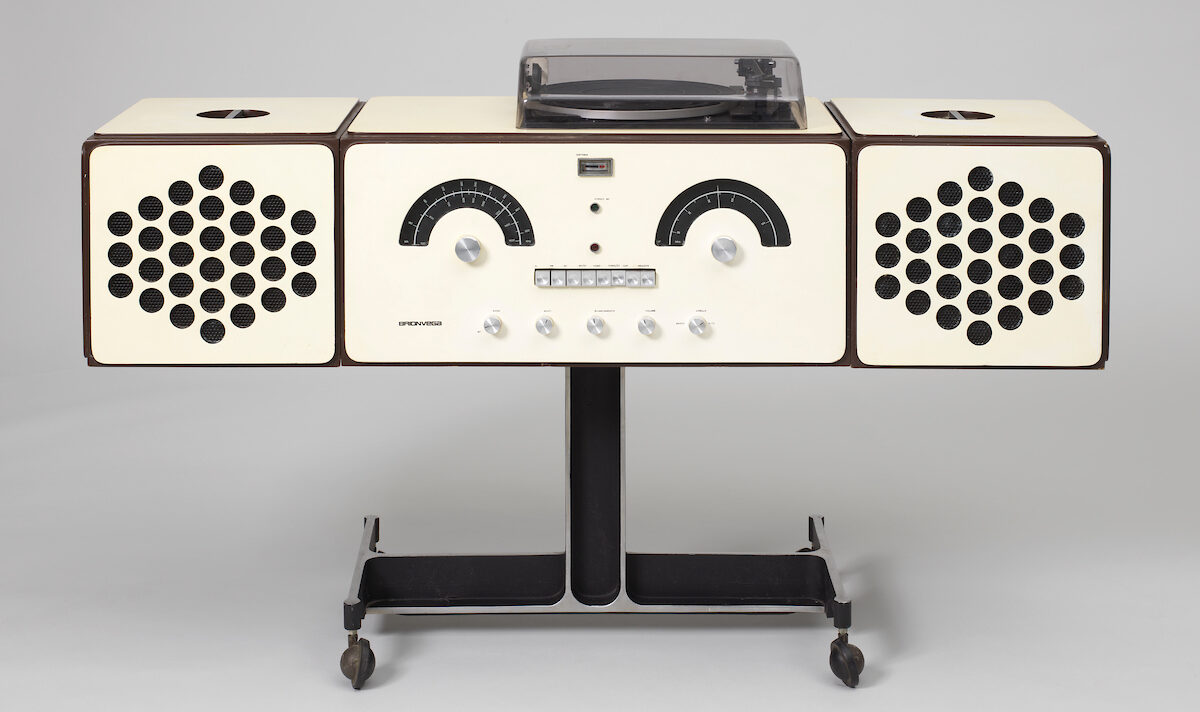
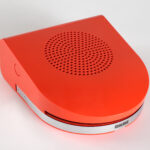
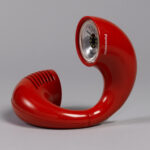
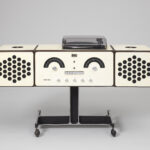
RR-126 Radio-Phonograph, 1965; Designed by Achille Castiglioni (Italian, 1918-2002) and Pier Giacomo Castiglioni, (Italian, 1913-1968); Manufactured by Brionvega, S.p.A (Milan, Italy); Plywood, plastic, aluminum, polycarbonate, electronic components; H x W x D (speakers on sides): 46.5 × 121 × 36.5 cm (18 5/16 × 47 5/8 × 14 3/8 in.); H x W x D (speakers on top): 92.5 × 61.5 × 36.5 cm (36 7/16 × 24 3/16 × 14 3/8 in.); Cooper Hewitt, Smithsonian Design Museum; Gift of George R. Kravis II, 2018-22-96-a/c; Photo: Matt Flynn
Art of Noise shows how design shapes the way we experience music—how and where we listen to it, how it’s communicated visually, and what we choose to hear. For many people, these design choices feel like a part of the music itself; they become a key part of how we remember and understand sound in a multisensory way—through our ears, our eyes, and our sense of touch.
Organized by the San Francisco Museum of Modern Art (SFMOMA) and adapted to the history of the New York music scene for its East Coast presentation, Art of Noise presents hundreds of works that have shaped our relationship to music over the past century. From concert posters to record albums, phonographs to digital music players, handheld radios to sound systems, the exhibition demonstrates how our experiences are built by both the sounds we hear and the objects that help illustrate or activate them, whether through color and composition or through form, material, and mechanics.
AMPLIFYING MUSIC THROUGH GROUNDBREAKING GRAPHIC DESIGN
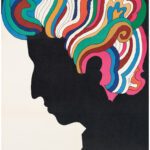
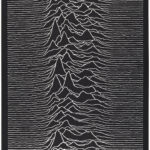
Unforgettable album covers, flamboyant posters, and eye-catching flyers demonstrate graphic design’s ability to provide a visual accompaniment to auditory experiences. These visual outputs are so correlated with the sound that genres of music are often associated with specific typographic styles, color palettes, and even production techniques—from hand-drawn to photocopied to digitally manipulated.
MUSIC TECHNOLOGY AND INNOVATIVE PRODUCT DESIGN
The look and feel of music players—including radios, stereos, boomboxes, turntables, and portable devices—has developed alongside advancements in technology and evolving cultural aesthetics. Art of Noise maps these expressive styles and iconic product designs, from the mechanical and analog playback devices of a hundred years ago to the modern tools that deliver nearly infinite access to digital streaming.
LISTENING ROOM BY DEVON TURNBULL
Central to the exhibition’s experience and located on the first floor of Cooper Hewitt is HiFi Pursuit Listening Room Dream No. 3, a large-scale, handmade, audio system by multi-disciplinary artist Devon Turnbull. The listening room is programmed daily and activated throughout the run of the exhibition with either special live operator appearances or genre specific playlists.
EXHIBITION DESIGN BY TEENAGE ENGINEERING
The exhibition environment is designed in collaboration with Stockholm-based teenage engineering, whose groundbreaking speakers and synthesizers have garnered an international following. Museum visitors will encounter a new interactive seating environment designed by teenage engineering with a custom-designed device for audio playback that allows visitors to interact and discover new music. The device contains curated playlists that span genres and eras, with songs focused on the incredible range of music created or augmented in New York.
Verner Panton, 3300 Stereo, 1963; San Francisco Museum of Modern Art, Accessions Committee purchase, by exchange, through a gift of Michael D. Abrams; photo: Don Ross
Mario Bellini, Pop Automatic Record Player, 1968; San Francisco Museum of Modern Art, bequest of the George R. Kravis II Collection; photo: Katherine Du Tiel
Thilo Oerke and Rosita Tonmöbel, Rosita Vision 2000, 1971; San Francisco Museum of Modern Art, Accessions Committee purchase, by exchange, through a gift of Michael D. Abrams; photo: Don Ross
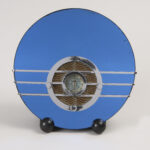
Model 566 Bluebird Radio, 1934; Designed by Walter Dorwin Teague (American, 1883–1960); Manufactured by Sparks-Withington Co. (Jackson, Michigan, USA); Glass, chrome-plated steel, wood, paint, textile, electronic components; H x W x D: 36.2 × 36.8 × 17.8 cm (14 1/4 in. × 14 1/2 in. × 7 in.); Cooper Hewitt, Smithsonian Design Museum; Gift of George R. Kravis II, 2018-22-1; Photo: Matt Flynn
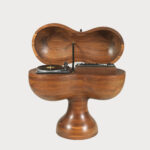
Stereo Chest, 1973; Designed and made by Wendell Castle (American, 1932-2018); Stack-laminated and carved walnut, leather, metal, rubber, plastic, electronic components; Dual 1229 turntable, Kenwood model KR-5150 receiver; H x W x D (open): 150 x 109.2 x 76 cm (59 1/16 x 43 x 29 15/16 in.); H x W x D (closed): 113.3 x 109.2 x 55.9 cm (44 5/8 x 43 x 22 in.); Cooper Hewitt, Smithsonian Design Museum; Gift of Linda and Irwin R. Berman, 2005-9-1-a/e; Photo: Ellen McDermott
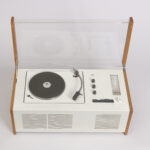
SK 55 Radio-Phonograph, 1963; Designed by Dieter Rams (German, born 1932) and Hans Gugelot (German, 1920-1965); Manufactured by Braun AG (Frankfurt, Germany); Metal, plastic, ash wood; Cooper Hewitt, Smithsonian Design Museum; Gift of Barry Friedman and Patricia Pastor, 1986-99-6; Photo: Matt Flynn
R-72 Toot-a-Loop Portable Radio, 1971; Designed by Daisuke Kajiwara (Japanese); Manufactured by National Panasonic Radio brand, Matushita Electrical Industrial Co, Ltd. (Osaka, Japan); Plastic (ABS), metal, electronic components; H x W x D (open): 15.5 × 15 × 13.5 cm (6 1/8 × 5 7/8 × 5 5/16 in.); H x diam. (closed): 7.6 × 15.6 cm (3 × 6 1/8 in.); Cooper Hewitt, Smithsonian Design Museum; Gift of Jacqueline Loewe Fowler, 2007-37-5; Photo: Ellen McDermott
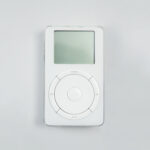
iPod Digital Music Player, 2001; Designed by Jonathan Ive (British, born 1967) and Apple Industrial Design Team; Manufactured by Apple (Cupertino, California, USA); Plastic, polycarbonate, stainless steel, electronic components; H x W x D: 10.4 x 6.1 x 1.9 cm (4 1/8 x 2 3/8 x 3/4 in.); Cooper Hewitt, Smithsonian Design Museum; Gift of David and Kelly Theresa Linton, 2009-49-1; Photo: Matt Flynn
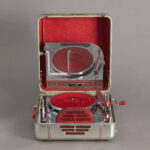
Special Model M Phonograph, ca. 1935; Housing designed by John Vassos (American, born Romania, 1898-1985); Mechanism designed by Alfred Weiland (American, 1887-1975), Selden T. Williams (American, 1892-1983); Manufactured by RCA Victor (New York, NY, USA); Aluminum, chromium-plated steel, metal, plastic, felt, leather, velvet; H x W x D (open): 58.4 × 41.9 × 52.1 cm (23 in. × 16 1/2 in. × 20 1/2 in.); H x W x D (closed): 20.3 × 41.9 × 45.7 cm (8 in. × 16 1/2 in. × 18 in.); Cooper Hewitt, Smithsonian Design Museum; Gift of George R. Kravis II, 2016-5-11; Photo: Matt Flynn
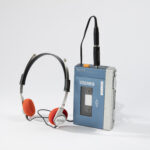
TPS-L2-Walkman Cassette Player and MDR-3L2 Headphones, 1979; Designed by Akio Morita (Japanese, 1921-1999) and Kozo Ohsone (Japanese, born 1933); Manufactured by Sony Corporation (Tokyo, Japan); Plastic, aluminum, steel, polyurethane, electronic components; H x W x D (cassette player): 13 × 8.7 × 3 cm (5 1/8 × 3 7/16 × 1 3/16 in.); H x W x D (headphones): 16.5 × 14.2 × 4 cm (6 1/2 × 5 9/16 × 1 9/16 in.); Cooper Hewitt, Smithsonian Design Museum; Gift of Robert M. Greenberg, 2017-51-4-a/c; Photo: Matt Flynn
RR-126 Radio-Phonograph, 1965; Designed by Achille Castiglioni (Italian, 1918-2002) and Pier Giacomo Castiglioni, (Italian, 1913-1968); Manufactured by Brionvega, S.p.A (Milan, Italy); Plywood, plastic, aluminum, polycarbonate, electronic components; H x W x D (speakers on sides): 46.5 × 121 × 36.5 cm (18 5/16 × 47 5/8 × 14 3/8 in.); H x W x D (speakers on top): 92.5 × 61.5 × 36.5 cm (36 7/16 × 24 3/16 × 14 3/8 in.); Cooper Hewitt, Smithsonian Design Museum; Gift of George R. Kravis II, 2018-22-96-a/c; Photo: Matt Flynn
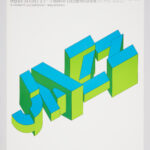
Poster, 11th Summer Jazz Festival, 1979; Takenobu Igarashi (Japanese, 1944–2025) for Nippon Cultural Broadcasting, Inc. (Tokyo, Japan); Printed by KY Printing Co. Ltd. (Japan); Lithograph on paper; 72.8 × 51.5 cm (28 11/16 × 20 1/4 in.); Cooper Hewitt, Smithsonian Design Museum; Gift of Takenobu Igarashi, 2018-18-14; Photo: Matt Flynn
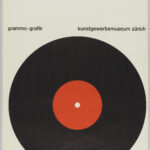
Poster, Grammo-Grafik [Record Graphics], 1957; Gottlieb Soland (Swiss, born 1928) for Kunstgewerbemuseum (Zurich, Switzerland); Lithograph on wove paper; 100.2 × 70.3 cm (39 7/16 × 27 11/16 in.); Cooper Hewitt, Smithsonian Design Museum; Gift of Sara and Marc Benda, 2009-12-19; Photo: Matt Flynn
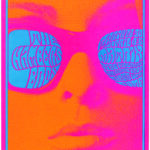
Poster, Chambers Brothers Band, Neon Rose #12; Victor Moscoso (Spanish, active USA, born 1936); Published by Neon Rose (San Francisco, California, USA); Printed by Graphic Arts of Marin (California, USA) and Cal Litho (California, USA); Lithograph on wove paper; 51 × 36 cm (20 1/16 × 14 3/16 in.); Cooper Hewitt, Smithsonian Design Museum; Gift of Sara and Marc Benda, 2009-12-23; Photo: Matt Flynn
ENHANCE YOUR VISIT
Enhance your visit with Bloomberg Connects, the free arts and culture app.
ACCESSIBILITY
Various resources are available to support your visit to Art of Noise. All in-gallery videos will have sound descriptions. Image descriptions will be available on the exhibition’s accessibility webpage. Large print labels, sound dampening over-ear headphones, and other sensory materials will be available for use in the galleries. Visit the In-Gallery Resources page to learn more. More information about accessibility at Cooper Hewitt is available on the museum’s website.
ACKNOWLEDGMENTS
Art of Noise is organized by SFMOMA and curated by Joseph Becker, Curator of Architecture and Design, SFMOMA, with support from Divya Saraf, former Curatorial Assistant in Architecture and Design, SFMOMA. The presentation at Cooper Hewitt is curated by Joseph Becker with support from Cynthia Trope, Associate Curator of Product Design and Decorative Arts.
Exhibition design by teenage engineering. Architect of Record, and fabrication by Pink Sparrow. Exhibition graphic design by Associate.
SUPPORT
This exhibition is made possible by the August Heckscher Exhibition Fund, the Ehrenkranz Fund, the Barbara and Morton Mandel Design Gallery Endowment Fund, the Fisher Arts Impact Fund, and Jonathan Schroeder and Janet Borgerson.
Featured Image:
RR-126 Radio-Phonograph, 1965; Designed by Achille Castiglioni (Italian, 1918-2002) and Pier Giacomo Castiglioni, (Italian, 1913-1968); Manufactured by Brionvega, S.p.A (Milan, Italy); Plywood, plastic, aluminum, polycarbonate, electronic components; H x W x D (speakers on sides): 46.5 × 121 × 36.5 cm (18 5/16 × 47 5/8 × 14 3/8 in.); H x W x D (speakers on top): 92.5 × 61.5 × 36.5 cm (36 7/16 × 24 3/16 × 14 3/8 in.); Cooper Hewitt, Smithsonian Design Museum; Gift of George R. Kravis II, 2018-22-96-a/c; Photo: Matt Flynn