Announcing the 2026 Winners

ANNOUNCING THE 2026 REGIONAL WINNERS AND THE NATIONAL HIGH SCHOOL DESIGN COMPETITION MAP!
Cooper Hewitt is pleased to announce the five regional winners of the 2026 National High School Design Competition and the launch of an interactive map featuring select student entries from across the country. In celebration of the 250th anniversary of the United States, the 2026 competition invited teens to identify an impactful design in their community’s past and propose a new design to help shape its future. After reviewing thoughtful entries from 24 states, Cooper Hewitt selected 155 exemplary entries to represent communities around the nation. We invite you to explore the interactive map and discover the diversity, creativity, and innovation embodied in these outstanding student designs.
Regional winners are indicated on the map with a star.
To access a list view of this map, click here
THE 2026 REGIONAL WINNERS
An esteemed panel of judges selected this year’s regional winners from the Midwest, Northeast, Northwest, Southeast, and Southwest:
- Dr. Monique Chism, Under Secretary for Education, Smithsonian Institution
- Claire Christianson, Design Engineer and Artist, 2016 National High School Design Competition Winner
- Carrie Kotcho, Assistant Director, Education & Visitor Experience, National Museum of American History
- Andy Mink, Director of Rural Initiatives, Smithsonian Institution
- Kim Robledo-Diga, Director of Learning & Audience Engagement, Cooper Hewitt, Smithsonian Design Museum
The five regional winners honor the history of their communities and demonstrate forward-thinking innovation. Each design represents optimism for our nation’s next 250 years, pairing local significance with scalability to create wider ripples of change.
Kalina
Prospect High School
Cook County, IL
Student Design
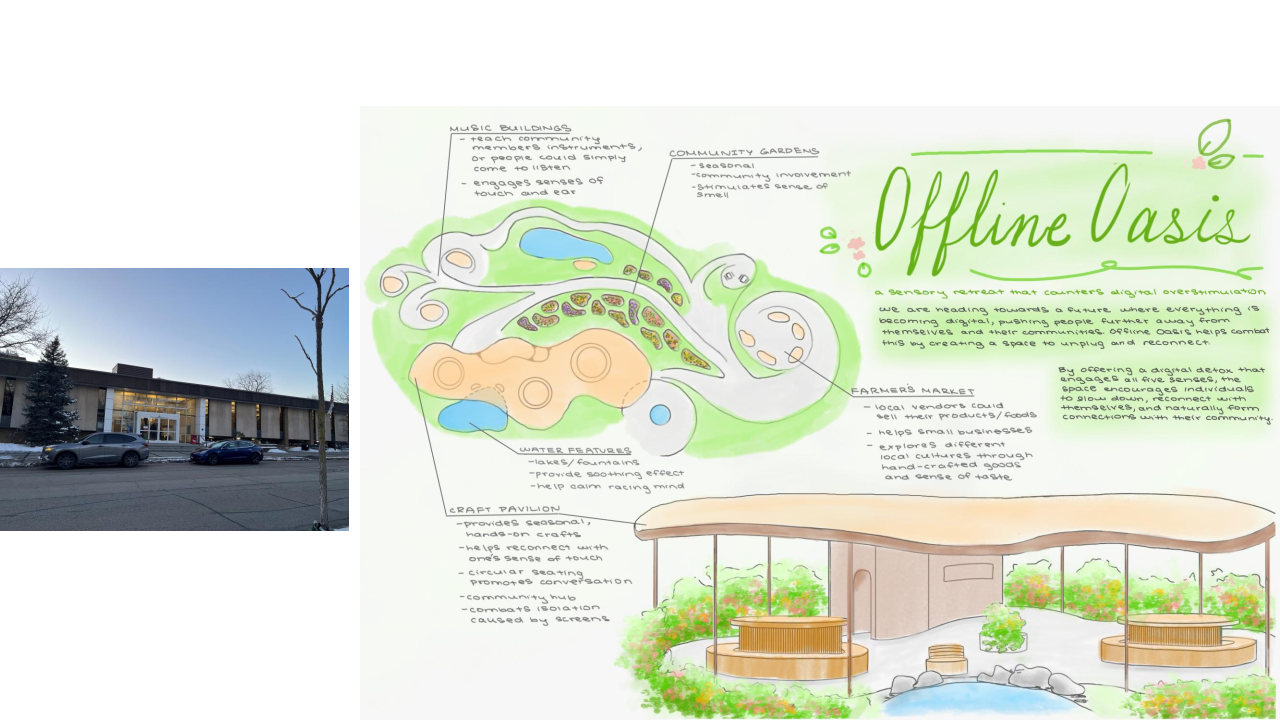
Strong connections to oneself and community are essential for well-being, yet increasing dependence on technology has led to widespread digital overstimulation and social isolation. Offline Oasis responds by creating a space that encourages individuals to slow down and reconnect with themselves while also supporting meaningful interaction. Through sensory spaces, the design helps people unplug and reconnect. Its flexible, replicable structure allows it to be adapted nationwide, supporting healthier, more connected communities across the United States.
Design from the Community
Designed by Walter Kroeber, the Arlington Heights Memorial Library supports its community in countless ways. Its programs serve people of all ages, from children discovering creativity to immigrants seeking learning opportunities and seniors finding connection. The library acts as a second home, reflecting the community’s inclusivity and shared identity.

Leehyun, Seoyoon, and Celine
The Taft School, Kent School, and Deerfield Academy
Litchfield County, CT; and Franklin County, MA
Student Design
Our “Undulating Landscape” replaces rigid linear desks with a multi-functional, organic environment for kindergarteners. Children naturally transition between recessed curves for quiet rest and elevated ridges that serve as intuitive surfaces for creative work. This fluid design rejects stiff postures, encouraging imaginative movement and sensory engagement. By prioritizing flexible, non-linear forms, it transforms classrooms into dynamic hubs for cognitive growth, offering a scalable model for healthier, more creative learning environments nationwide.
Design from the Community
Steelcase’s desks define our community’s industrial identity, yet they create conflict in my sibling’s kindergarten. While these rigid forms deserve preservation as historical artifacts, their linear stiffness remains fundamentally at odds with the flexible, organic environment required for a child’s natural development and creative play.
Sol
Orange County School of the Arts
Orange County, CA
Student Design
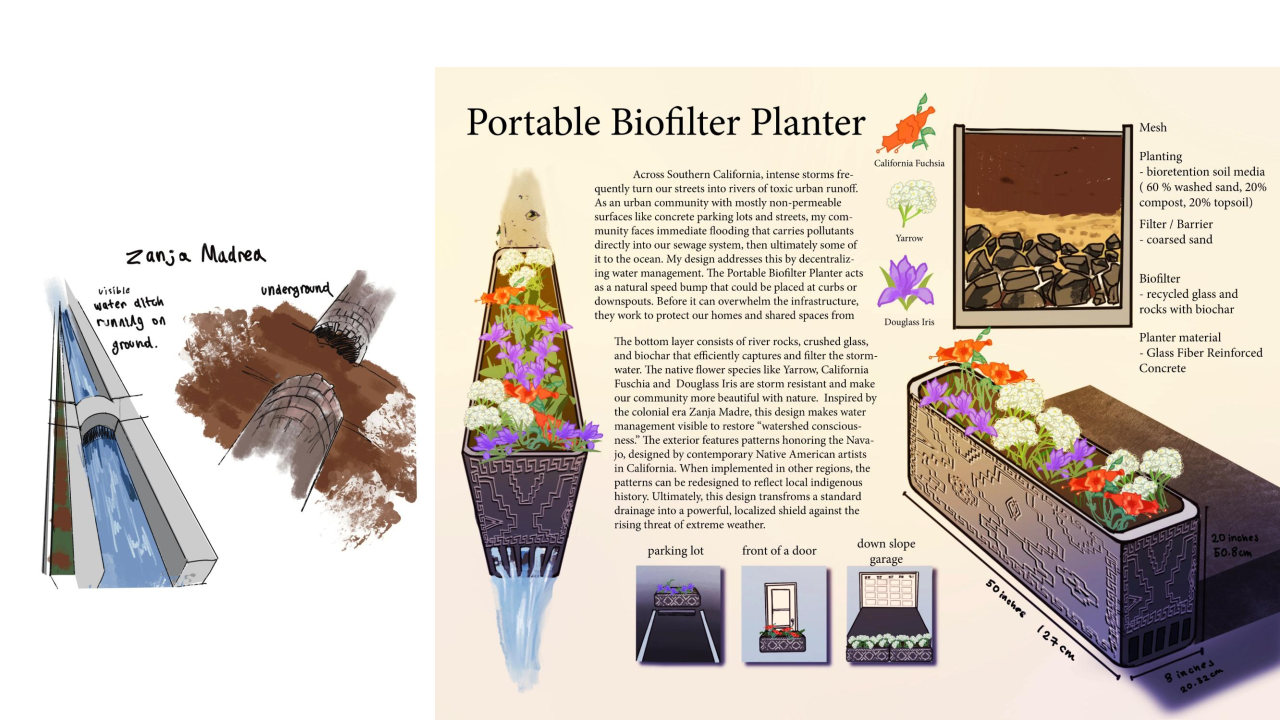
Urban runoff affects all Southern Californians, especially people in Santa Ana. This Portable Biofilter Planter captures pollutants before they reach sewers. Inspired by the Zanja Madre’s visible water management, it utilizes river stones and native plants to slow floods at curbs and parking lots. By slowing floodwaters on-site, it protects homes and streets. This decentralized system can be scaled nationwide, replacing hidden drainage with beautiful flowers and community-specific design on the side.
Design from the Community
The Zanja Madre is a colonial-era, gravity-fed irrigation system that diverted river water to the pueblo, transforming arid valleys into an agricultural powerhouse. It was a visible, open part of daily life that forced the community to interact, fostering a shared identity rooted in communal stewardship.
Junaid
Independence High School
Williamson County, TN
Student Design
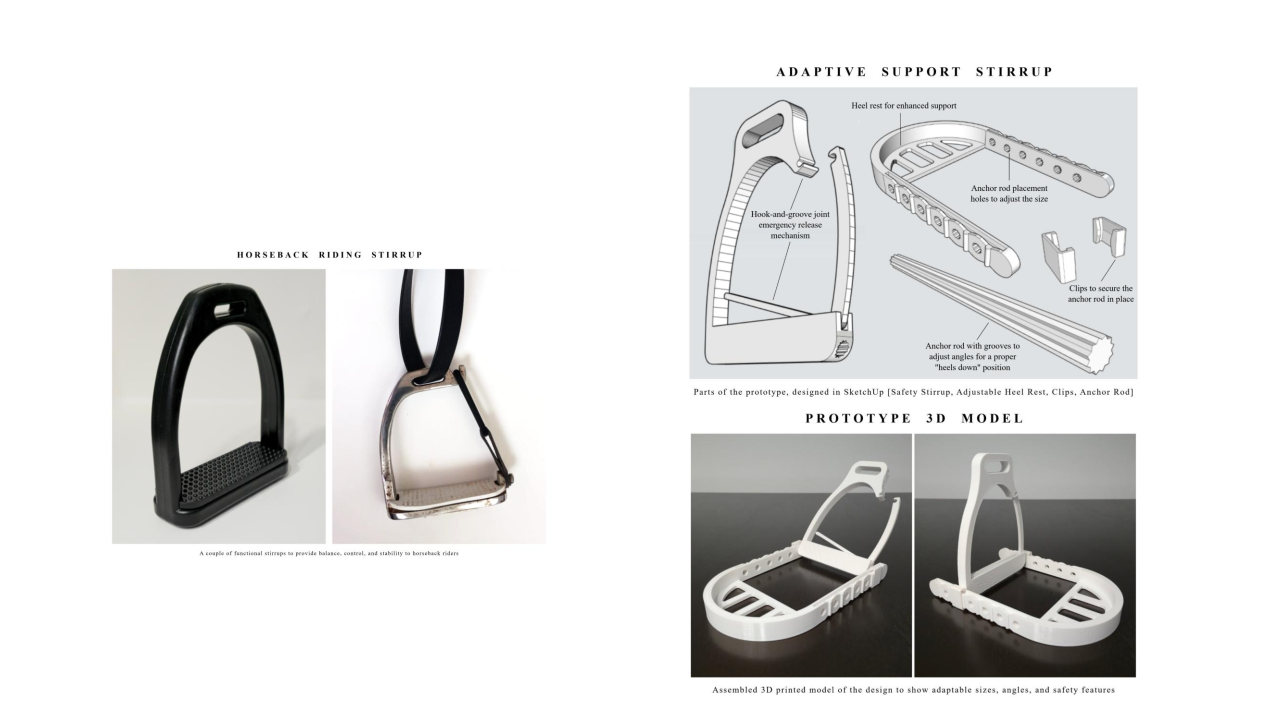
As someone with special needs, therapeutic horseback riding has fostered inclusion, healing, and growth for individuals like me in communities across our nation. Standard stirrups are often inadequate for riders who require enhanced support and safety. This patent-pending specialized stirrup, featuring a heel rest with adjustable size and angle, promotes participation by supporting riders with limited mobility, while its hook-and-groove joint releases under lateral pressure to prevent a rider from being dragged if they fall.
Design from the Community
The equestrian stirrup embodies centuries of history, innovation, and the partnership between humans and horses, anchoring a diverse equestrian community of ranchers, athletes, recreational riders, and therapeutic programs. By providing riders with balance, control, and stability—advancing agriculture, frontier expansion, transportation, and cavalry—the stirrup helped forge a strong and resilient nation.
Ish
Liberty High School
Collin County, TX
Student Design
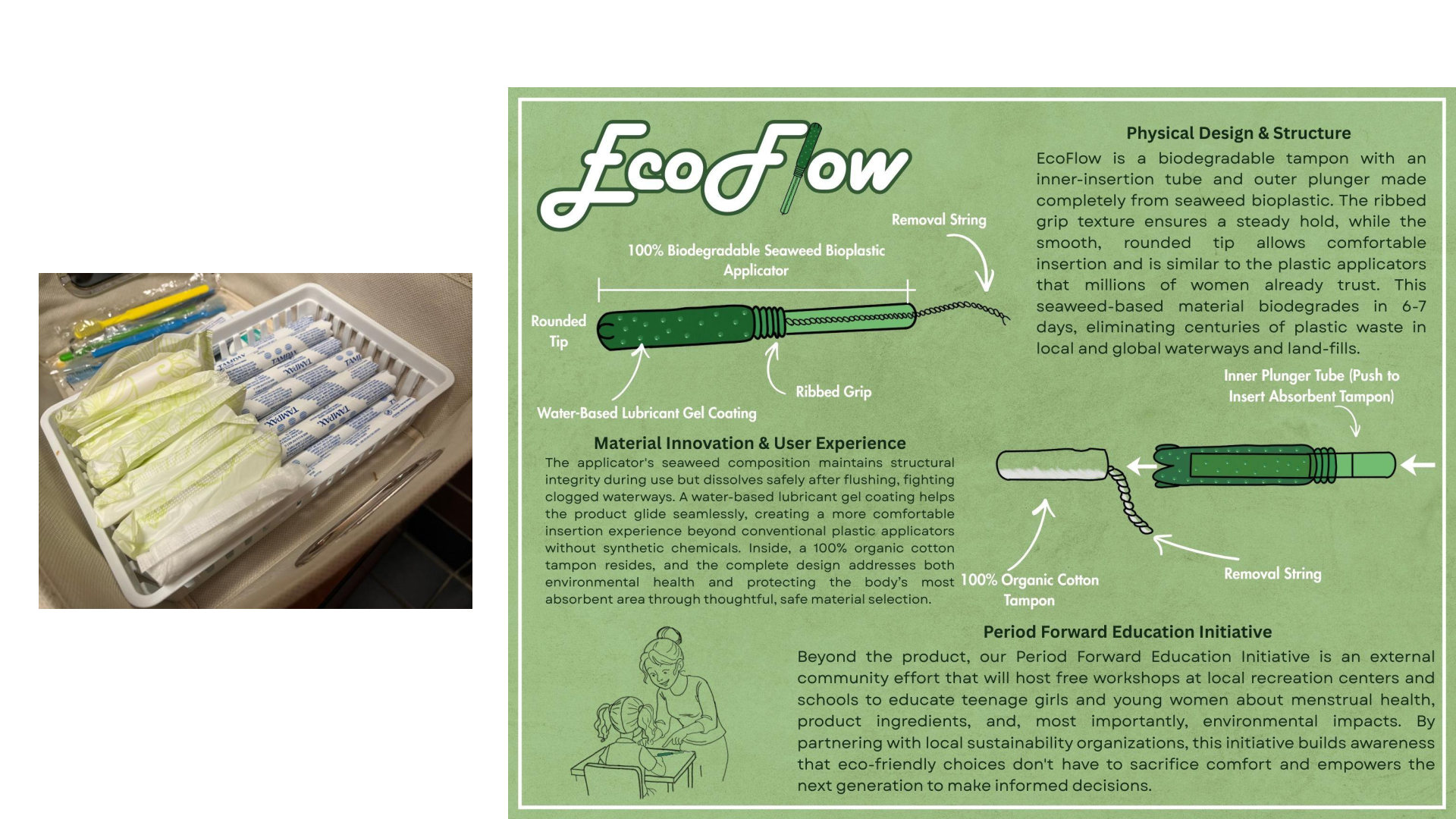
EcoFlow addresses menstrual waste polluting Frisco’s waterways and landfills, impacting our community’s environment. This biodegradable tampon applicator is made from compressed seaweed bioplastic with a water-based lubricant coating. The ribbed grip and rounded tip maintain familiar handling while decomposing in 6-7 days after flushing, versus 500 years for plastic. Paired with organic cotton, it eliminates plastic waste, and EcoFlow adapts existing dispensers with sustainable alternatives, offering nationwide scalability for 100+ million daily tampon users.
Design from the Community
This basket contains free menstrual products in Frisco ISD school bathrooms, providing tampons and pads to students. It represents our community’s commitment to health equity and dignity, ensuring no student misses class due to a lack of access. However, the plastic applicators create environmental waste in local waterways and landfills.
