Frederic Church in Jamaica In-Gallery Resources
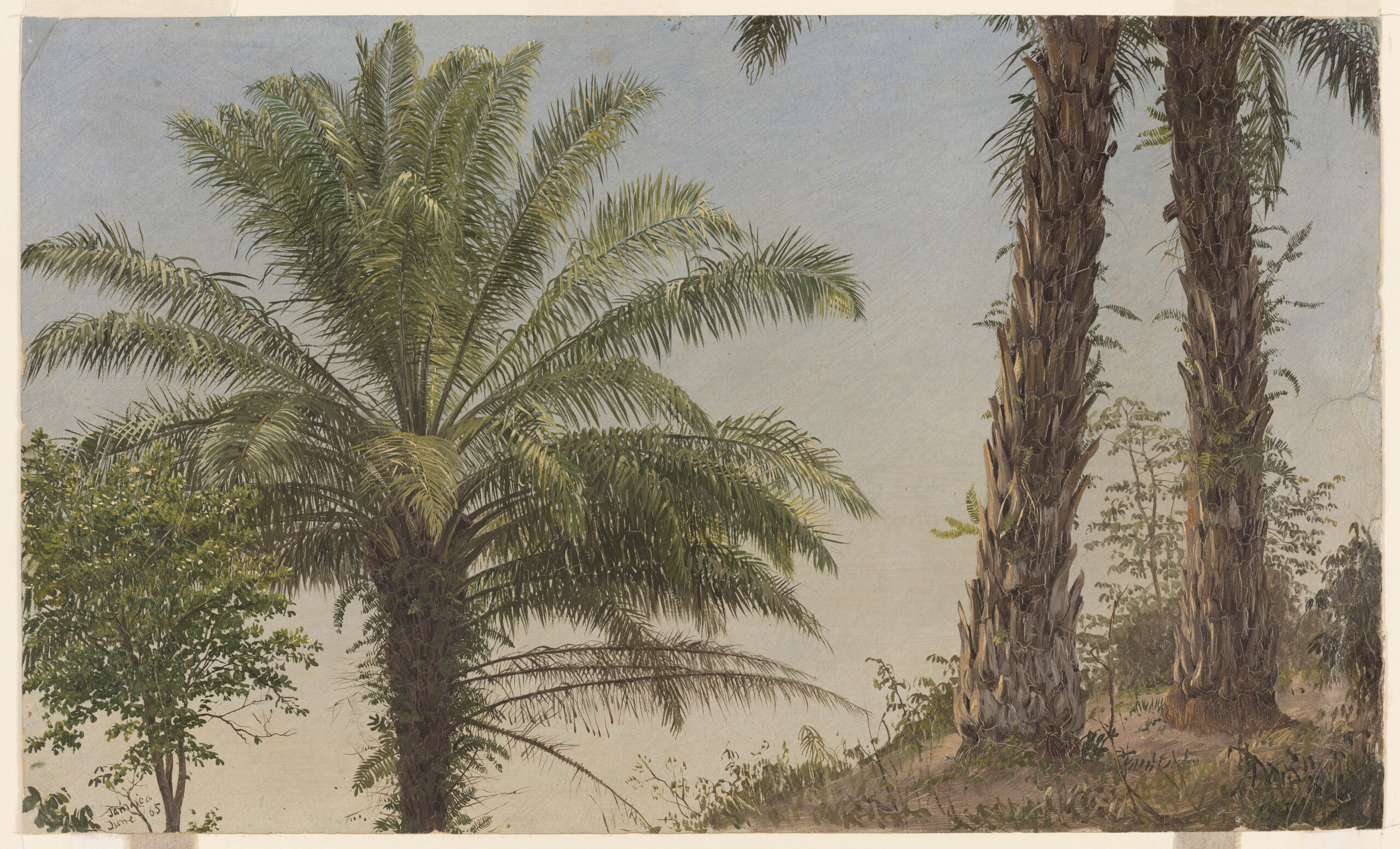
Very detailed painted botanical sketch of three palm trees growing on a steep hillside in Jamaica.

The following resources have been designed to support your visit to the exhibition. 

Resources for the Frederic Church in Jamaica exhibition include a sensory map, large print labels, and object descriptions. 

Visit Accessibility at Cooper Hewitt to learn more about general accessibility at the museum.

What to Expect

Frederic Church in Jamaica consists of three galleries on the second floor of Cooper Hewitt. The exhibition includes sketches by Frederic Church, as well as objects from Jamaica and historical books and photographs that provide insight into the people, places, and histories connected to his work. Review the exhibition sections below to get a preview of exhibition themes and access audio content organized by section. 

There is seating in select exhibition galleries. Refer to the Visitor Guide for specific locations of the seating. Portable gallery stools are available on each floor of the museum. The exhibition is wheelchair accessible. 

View the Sensory Map of this exhibition, as well as other areas of the museum. Use the printed Large Print Label booklet or digital Large Print Labels below to access a high contrast version of exhibition text and images of objects on view.

Large Print Labels

A screen-reader accessible Large Print version of the exhibition labels is available digitally. This document also has a visual description of each object. Click this link to access.

You can borrow a printed version of the Large Print labels at the museum. The Large Print label booklet is available near the exhibition’s introductory text.

Behind the Scenes Audio content

Listen to Caitlin Condell, Exhibition Curator, discuss the exhibition. The recordings are organized by exhibition section below. All recordings have transcripts. You can also download the Bloomberg Connects app or visit BloombergConnects.org to access the recordings.

Exhibition Sections

In April 1865, at the end of the US Civil War, the American painter Frederic Church (1826–1900) traveled to Jamaica. At thirty-nine years old, Church was acclaimed in the United States for his monumental and astonishingly detailed landscape paintings. He was an intrepid traveler, regularly journeying around the globe in search of inspiration for his pictures. But his trip to Jamaica was different. Grieving the recent deaths of his two young children from diphtheria, Church and his wife, Isabel, sailed to the Caribbean seeking respite.

While Church sought personal solace in observing the majestic Jamaican landscape, Black Jamaicans lived in extreme poverty under British colonial rule. Every day for five months, Church trekked on foot and by horse to sketch plants and capture wondrous atmospheric effects from mountain peaks. Whether executed in moments or over the course of hours, these sketches reveal Church’s extraordinary artistic range. Yet, absent from these breathtaking studies is both the artist’s private anguish and the public turmoil engulfing the country. Instead, it is his passion for nature that is felt through the intensity with which he captures the fleeting light of the sunset and his meticulously accurate botanical studies of indigenous vegetation.

Celebrating the two hundredth anniversary of Frederic Church’s birth, this exhibition draws from Cooper Hewitt’s holdings of over two thousand of the artists’ oil and graphite sketches, the largest collection of Church works in the world. These sketches offer a window into the process of one of America’s most influential artists. Shown together, they serve as a reminder of the expressive and healing power of drawing from nature and the complexity of memory imbued in the land.

Access the Large Print Labels with visual descriptions for this exhibition.

Hear from the Curator

20. Welcome from Caitlin Condell, Exhibition Curator

Transcript:

Hi, I’m Caitlin Condell, curator of Frederic Church in Jamaica. The story of this exhibition starts in April 1865, at the end of the United States Civil War, when Frederic Church, already an acclaimed landscape painter in his native America, traveled to Jamaica. He regularly journeyed around the globe in search of inspiration for his work, but this trip was different. Grieving the recent deaths of his two young children from diphtheria, Church and his wife, Isabel, sailed to the Caribbean seeking respite. While Church sought solace in observing the majestic Jamaican landscape, Black Jamaicans lived in extreme poverty under British colonial rule.

The works you will encounter in this exhibition are testament to Church’s passionate study of Jamaican nature during a period marked by private grief. They also capture landscapes that bore witness to the intense turmoil engulfing the country at that time. The various audio stops within Frederic Church in Jamaica highlight the motivations Church and his wife, Isabel, had for personally engaging with nature on the island. While Church captured landscapes in his process sketches, what stories might surface as you look closely at the works and listen to the companion historical narratives?

21. Tree Fern

Transcript:

“Mrs. Church is insane on the fern question,” Frederic Church wrote to Joseph B. Austin, his friend and patron. Isabel, bereft after the devastating deaths of her two young children, had thrown herself into the popular Victorian pastime of fern collecting. The remarkable diversity of hundreds of fern species in Jamaica, which range in size from mere inches to many feet, was part of the appeal. But the British romantic aesthetic sensibility also prized ferns for their flowerless elegance. Fern fever, as some called it, had become popular after the invention in the 1830s, of a glass case known as the Wardian Box, which enabled travelers to protect delicate plant species obtained in the Caribbean, and transport them by sea, protected from salt spray. Unlike other species, ferns were unusually adaptable to different climates. When Isabel and Frederic returned to New York in September of 1865, they brought back with them live species to plant on their own property.

Though the transportation of living specimens gave rise to the mania for ferns, many collectors also focused on pressing ferns in books. Isabel maintained this practice throughout her time in Jamaica, and her book of ferns remained a cherished object for the rest of her life.

22. Blue Mountains near Kingston

Transcript:

By early March 1865, a series of union victories suggested that an end to the Civil War that had ravaged the United States was imminent.

On March 4th, President Abraham Lincoln delivered a speech at his second inauguration, pledging to bind up the nation’s wounds and work towards a lasting peace.

Frederic and Isabel Church were happily ensconced at their farm with their two young children, Herbert and Emma. Within days of the inauguration, Herbert, known affectionately as Birdie, developed a cough and a fever. What was first believed to be a cold suddenly turned dire as Birdie struggled to breathe. Frederic and Isabel watched helplessly as their two-year-old son succumbed to Diphtheria on March 18th. By the time Birdie was buried, Emma, their five-month-old daughter, had begun suffering from similar symptoms. She died just eight days after her brother. The loss was unfathomable, and Frederic and Isabel were overcome with grief.

Desperate to escape reminders of Birdie and Emma, Frederic Church began making arrangements for a trip that would give Isabel, as he put it, “A change of scene, air, and life.” Soon, he had booked them passage on a steamer named Montezuma, which would take them on the 1500-mile journey to the island of Jamaica. As they readied themselves for the trip in New York City, their private grief was amplified by the shocking news of Lincoln’s assassination. The war was over, but the nation was devastated. Frederick and Isabel boarded the Montezuma in a state of anguish, desperate to lose themselves in the Blue Mountains of Jamaica.

23. Jamaica

Transcript:

Elizabeth Hart Jarvis Colt was born into an affluent family, but it was her marriage to Samuel Colt, an arms manufacturer, that cemented her place atop a rarefied New England social circle. Known colloquially as the first lady of Hartford, Colt’s wealth did not protect her from experiencing personal tragedies. In the span of just several years, four of Colt’s five young children died, as did her husband in 1862. Samuel’s death left Colt a wealthy widow at the head of one of the largest American arms manufacturers supplying the Union Army during the Civil War. She was an outspoken abolitionist and suffragist and an active philanthropist.

As the Civil War drew to a close, Colt began work on establishing a picture gallery at her mansion in Hartford, Connecticut. She turned to her friend Frederic Church for guidance as she assembled a substantial collection of paintings and sculptures by American artists. Colt also commissioned Church to paint a monumental picture of a Jamaican scene to be the centerpiece of this private picture gallery. The large painting titled The Vale of St. Thomas was completed in 1867. When Church had the painting delivered to Colt, he also sent a large tree fern to be placed alongside the picture for dramatic effect.

24. Kitchen of Flamstead Cottage

Transcript:

After spending several months staying in the hamlet of Bellevue, just five miles from Kingston, Frederic and Isabel Church settled into residence at Galloway Hill in July. They were guests of Mr. Charles Fyfe, the clergyman at the Paris Church at Port Royal. Situated high up near the peak of the Port Royal Mountains, the location offered panoramic views of Kingston Harbor and the Caribbean Sea on one side and the Blue Mountains on the other.

Galloway Hill was adjacent to Flamstead Great House, the summer residence of the British colonial governor, Edward John Eyre. The location had been used by the indigenous Taíno people as a lookout point in the 15th century. By the 17th century, first Spanish and then British colonial governors were using the location as a naval lookout. By the time the Churches arrived at Jamaica, Flamstead was perhaps best known as the site of lavish summer parties and balls, which were hosted by Governor Eyre. Within weeks of Church’s departure from Jamaica, Governor Eyre was responsible for brutally suppressing Black Jamaicans’ protests over abject living conditions.

25. A Naturalist’s Sojourn in Jamaica

Transcript:

Born in Montego Bay in 1795, Richard Hill was a Jamaican lawyer, activist, and perhaps the first person of color to serve as a government official in Jamaica. Hill’s father, a white British merchant, and his mother, who held East Indian and African ancestry, were staunch advocates for the abolition of slavery. Following his education in England, Hill joined the anti-slavery society and spent two years in present day Haiti and Dominican Republic, observing living and social conditions. By 1823, Hill was a driving force behind the fight for equal rights in Jamaica amongst a group that identified as the free coloreds. Through his advocacy, the Jamaican Assembly granted Black Jamaicans the right to vote and to participate in the Jamaican colonial government. Hill was also a skilled and knowledgeable naturalist. His familiarity with the medicinal properties of local plants had enabled him to give relief to many Jamaicans during a devastating cholera epidemic.

A dedicated amateur ornithologist, Hill developed a list of native Jamaican bird species. In 1845, he struck up a friendship with the British naturalist, Philip Henry Gosse, who had arrived on the island the previous year to make a comprehensive study of Jamaican flora and fauna. Hill periodically traveled with Gosse to observe and capture specimens, and after Gosse returned to England, he sent his drafts of the manuscripts to be reviewed by Hill. Hill continued to publish throughout the rest of his life on the history of Jamaica, as well as its plants and animals.

Although slavery had been abolished in Jamaica in 1838, most Black Jamaicans still lived in extreme poverty under British colonial rule. High unemployment, resource exploitation, slavery-like conditions, and starvation were systemic. By early 1865, a group of civic leaders and the heads of the Native Baptist church organized Black Jamaicans to petition the British colonial government for livable wages, reasonable taxation, and access to land for cultivation. In response, the government removed several of their powerful allies from public office, including George William Gordon, an assemblyman and head of the Native Baptist church.

On October 11, 1865, several hundred Black Jamaicans marched to the capital of St. Thomas parish to protest the arrest warrant issued for Paul Bogle, an activist and deacon. After the protestors removed weapons from the local police station, a fight broke out that resulted in the deaths of eighteen militiamen and seven protestors. In the ensuing days, the British colonial government indiscriminately killed nearly five hundred Black Jamaicans and flogged six hundred more. More than a thousand homes were destroyed. Mass executions were ordered, and Bogle and Gordon were among those accused of treason and executed.

Access the Large Print Labels with visual descriptions for this case.

Church’s drawings and oil studies reflect his aspiration to accurately record details of light, color, and form, but also the emotional experience of a place or scene. Church sometimes balanced his desire for botanical accuracy with a desire to represent the overwhelming abundance of foliage and the shapes of the mountains. His graphite sketches are frequently annotated with brief notations that are both informative and poetic.

Access the Large Print Labels with visual descriptions for this gallery.