The Nova Reperta print series—produced by Stradanus in collaboration with Flemish printmaker Philips Galle and first published in 1591—was a “self-consciously modern” project, adopting the task of highlighting the most important innovations in recent European history. The Latin title has been translated to English as either New Discoveries or New Inventions of Modern Times, reflecting the variable interpretation of the term reperta. Encompassing both “invention” and “discovery,” the word’s dual connotations point toward a uniquely early modern vision of novelty.
Each print focuses on a different discovery of the modern era, with the ancient world serving as a temporal reference point for the construction of novelty. Thus, some of the innovations represented, including oil painting and silk production, predate Stradanus and his collaborators by centuries, but their “newness” derives from their development after antiquity, perceived as products of modern times. In terms of subject matter, several of the prints relate to technological innovations developed in workshop settings, notably printing, copper engraving, and distillation; others are tied to colonial and globalizing pursuits, such as the compass, sugar refining, and the discovery of America. The inclusion of particular subjects speaks to their contemporary relevancy, as well as the specific interests of Stradanus and his patron Luigi Alamanni.
Nova Reperta at Cooper Hewitt
Of the twenty prints in the complete series, preliminary sketches for nine of the plates are housed in Cooper Hewitt’s collection. The works are not in a finished state, but rather early steps in the artistic process, used to work out how concepts might be translated visually. The drawings also serve to exemplify the printing process; the working sketch was finalized as a modello, referring to a final drawing used as direct reference for the print, that was in turn sent to the engraver. The engraver would use a steel tool called a burin to cut the design into a copper plate. Finally, the plate was inked, and a sheet of paper would be pressed onto the inked plate to form an impression. As a consequence of this method, the images in the drawings are reversed in print form, a transformation that the artist certainly kept in mind while designing the original composition.

Figure 1: Drawing, The Invention of the Compass, ca. 1590; Jan van der Straet, called Stradanus (Flemish, 1523–1605); Pen and brown ink, brush and gray and brown wash over black chalk on laid paper; 10.7 × 14.6 cm (4 3/16 × 5 3/4 in.); Museum purchase through gift of various donors, 1901-39-302
Despite being from the early stages of print production, most of the drawings bear striking similarity to their finished counterparts. For example, the sketch (fig. 1) which ultimately becomes Lapis Polaris, Magnes (The Lodestone, The Magnet), or The Invention of the Compass (fig. 2), features a scholar bent over his desk, hand positioned nearly identically to the completed print. The pushed-out chair, flat basin, model ship, and corner bed all feature prominently in both images, with components as slight as the dog curled up at the foot of the desk appearing in each case. The final version does contribute new details that imbue the composition with greater depth and realism, such as the addition of a window along the back of the study, but the adjustments do not reflect any significant change in content. The only other notable addition is a new table to the right of the seated figure, covered in instruments of measurement. The view of ships outside and the supplemented tools, in addition to the ship model hanging above the desk, serve to underscore the ties between navigation, technology, and scholarship.
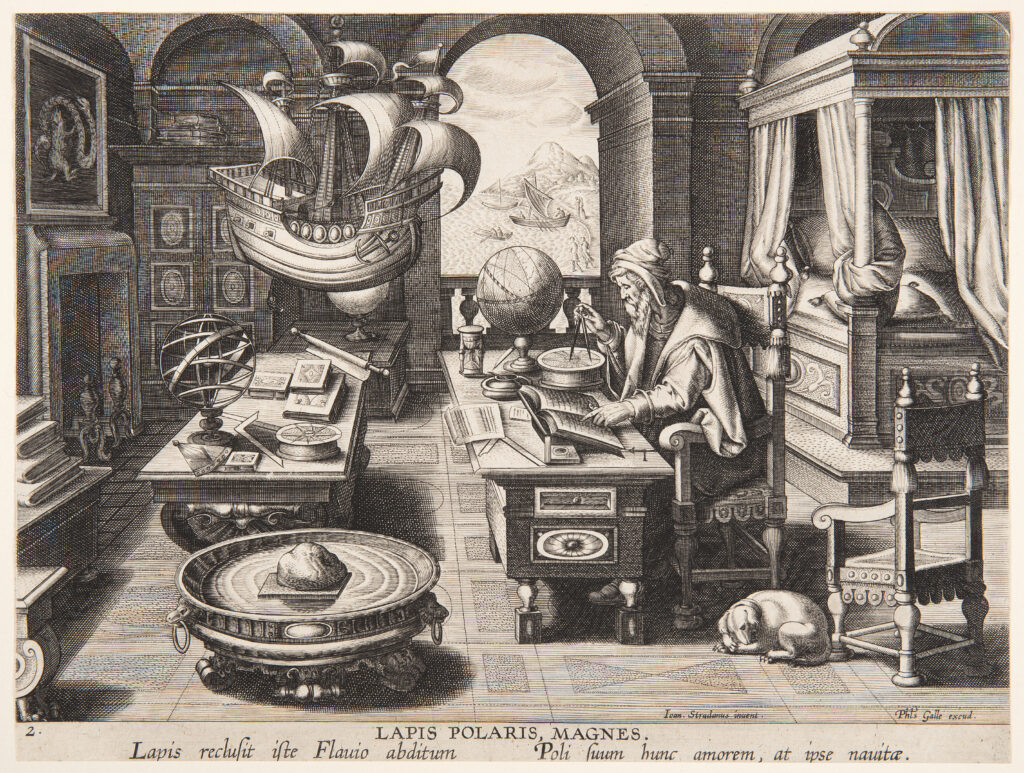
Figure 2: Print, Lapis Polaris Magnes (Invention of the Compass), ca. 1590; After Jan van der Straet, called Stradanus (Flemish, 1523–1605); Published by Philips Galle (Dutch, 1537–1612); Engraving on paper; 20 × 26.8 cm (7 7/8 × 10 9/16 in.); Museum purchase through gift of Samuel P. Avery, 1947-26-1
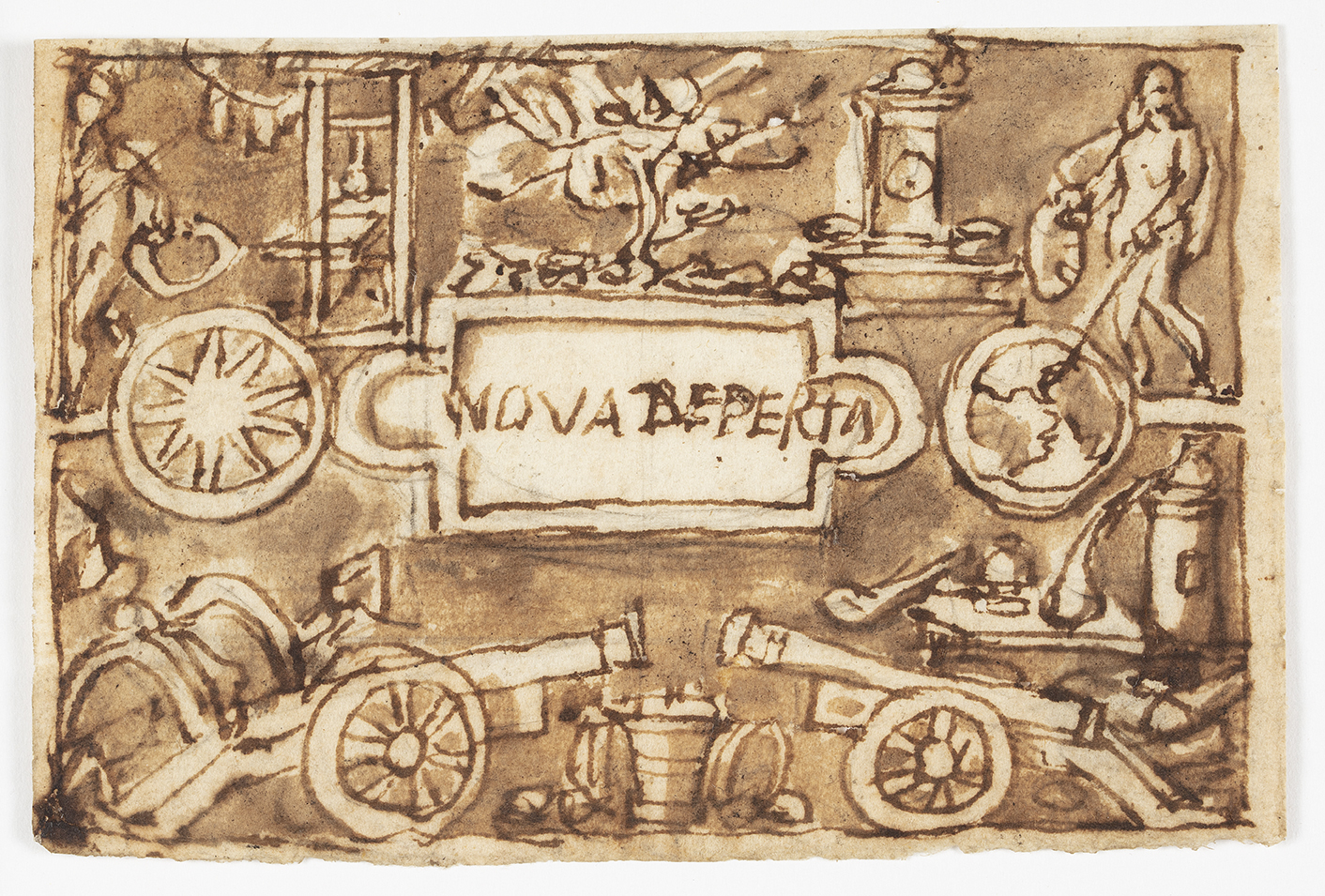
The sketch for the series frontispiece (Figure 3) differs more noticeably from the final print in its composition (Figure 4). The title is smaller in relation to the other elements and has been moved from the center to the upper margin, and the two cannons have become one. The final print appears less crowded, with more space given to the symbolic features. Still, the key elements of the design are present, even in the preliminary stage; two figures point to a map and an encircled star respectively, the words NOVA REPERTA are prominent featured, and the same collection of inventions are present: America, magnetism, the printing press, gunpowder, clockmaking, distillation, and silk production (represented by the mulberry tree). The final version adds representations of the stirrup and guaiacum to the extant depictions, thus highlighting the first nine plates in the set, but makes no cuts, suggesting the finalization of the list of inventions prior to the creation of the preliminary drawing. These comparisons reveal that by the time Stradanus began working on the sketches, the intellectual vision for the project had already crystallized, and his task as inventor was to work out compelling means of expression for those ideas.
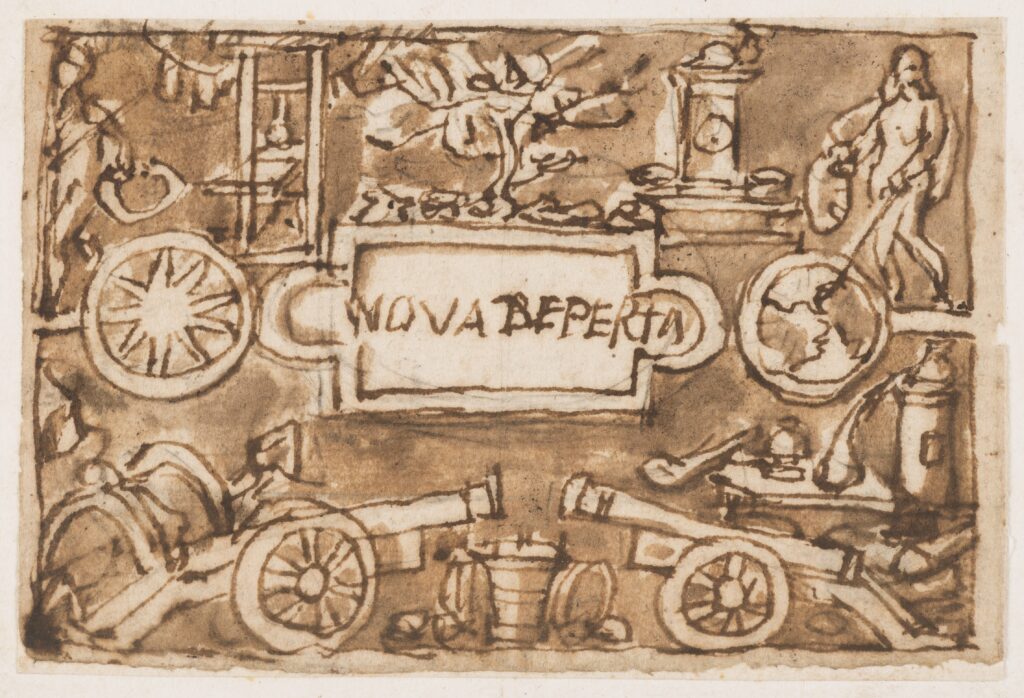
Figure 3: Drawing, Title Page, ca. 1590; Jan van der Straet, called Stradanus (Flemish, 1523–1605); Pen and brown ink, brush and brown and black wash over black chalk on laid paper; 7.1 × 10.7 cm (2 13/16 × 4 3/16 in.); Museum purchase through gift of various donors, 1901-39-149

Figure 4: Print, Title Page of “Nova Reperta,” ca. 1591; After Jan van der Straet, called Stradanus (Flemish, 1523–1605); Engraved by Jan Collaert II (Flemish, 1560–1628); Published by Philips Galle (Dutch, 1537–1612); Engraving on paper; 20.4 x 26.2 cm (8 1/16 x 10 5/16 in.); Museum purchase through gift of the Estate of David Wolfe Bishop, 1957-162-15
Stradanus and Alamanni: Making Intellectual Connections
Key to the development of the Nova Reperta was the relationship between Stradanus and Florentine intellectual Luigi Alamanni. The first recorded instance of the pair working together came in 1587, when Alamanni commissioned Stradanus for the creation of illustrations for a new edition of Dante’s Divine Comedy. The partnership continued into the following decade, and Alamanni is named as the dedicatee of the Nova Reperta on its frontispiece.
Alamanni’s active involvement in the formulation of the series is clear through the identification of notes in his hand on the backsides, known as versos, of several of Stradanus’ preparatory drawings. On the verso of an unrelated selection of hunt drawings, he outlines his vision for three of the Nova Reperta prints—distillation, gunpowder, and book printing—and names desired qualities and steps of the process to be depicted (Figure 5). The notation speaks to the consistent, relatively casual exchange of ideas between the pair, although within the context of their prescribed roles. As revealed by the content of the notes and the series dedication, Alamanni acted as auctor intellectualis, or the formulator of ideas for the series, and Stradanus served as inventor, realizing those ideas. Their connection exemplifies the typical relationship between artist and patron in the early modern period, with freedom of expression afforded to the artist through the visual interpretation of subject matter.

Figure 5: Drawing, Plan of a Fortified City, Inscription, ca. 1590; Jan van der Straet, called Stradanus (Flemish, 1523–1605); Pen and ink, brush and brown wash over black chalk on laid paper; 14.9 × 20.8 cm (5 7/8 × 8 3/16 in.); Museum purchase through gift of various donors, 1901-39-133v
The influence of Alamanni is also visible through the connections between the prints and the Accademia degli Alterati, of which Alamanni was an active member. The extensive records kept by the academy reveal discussions surrounding ancient versus modern usage of artillery, the conceptualization of history, and the attribution of America’s discovery, all themes which recur in the Nova Reperta. The conception of the explorer and the true attribution of America’s discovery were particularly hot topics among the Alterati; the main debate rested on whether Christopher Columbus, a Genoese man operating under the Spanish monarchy, or Amerigo Vespucci, a Florence native, should be considered the person who discovered the continent. The concern with the explorers’ places of origin reflects the intense political rivalries beginning to play out over colonial claims in the “New World.” Consequently, the selection of Vespucci as the person who discovered America in the Nova Reperta lends the print series a distinctly Florentine character, highlighting the city as a globally important locale. As such, the ideas that underlie the series emerge directly from the intellectual milieu of 16th century Florence and the academic circles frequented by Stradanus and his collaborators.
Inventing Invention: Who Made the Nova Reperta?
Through the process of designing the Nova Reperta and selecting certain subjects, Stradanus acts as the inventor of invention itself. The self-referential treatment of engraving and printing as “discoveries” situate him as a part of the wider socio-historical narrative at play. Still, the question of who can claim ownership of invention lingers. As was the case with the debates about Vespucci and Columbus among the Alterati, one might ask whether Stradanus or Alamanni should be considered the ultimate inventor. Stradanus’s name is the one which has become attached to the series, but this attribution also ignores the work of the engravers, Jan Collaert and Philips Galle.

Figure 6: Drawing, The Invention of Book Printing, ca. 1590; Jan van der Straet, called Stradanus (Flemish, 1523–1605); Pen and ink, brush and black wash over black chalk on laid paper; 10.8 × 15.2 cm (4 1/4 × 6 in.); Museum purchase through gift of various donors, 1901-39-301
The real answer to who “invented” the Nova Reperta may lie in the prints themselves. The majority of the images are set in workshop environments, emphasizing collaboration as central to advancement (Figure 6). This focus pushes back against the emerging notion of the artist as an individual, creating on the basis of some inherent seed of genius. The prints also reflect the period’s novel focus on empirical and artisanal forms of knowledge, in comparison to the medieval reliance on ancient textual authorities. The choice to depict the production process, rather than the moment of invention, highlights the artisan and their specialized knowledge, obtained and disseminated through practical experience. Furthermore, each of the aforementioned persons is credited by name on the prints, but even the unattributed laborers involved in the production and distribution of the series are rendered visible through the content of prints. Thus, invention is shown as taking place on individual and collective levels simultaneously.
The questions raised by the Nova Reperta surrounding originality, ownership, history, and novelty resonate with present-day concerns, relevant in a digital era where technological innovation is occurring at an unprecedented rate with yet-to-be-seen consequences. While the 21st-century viewer would certainly select a different set of “nova reperta” as representative of the modern world than Stradanus and Alamanni, the desire to define oneself and one’s times as uniquely progressive—for better or for worse—remains constant.
Rebecca Melin served as the 2025 Peter A. Krueger Intern in the department of Drawings, Prints & Graphic Design at Cooper Hewitt, Smithsonian Design Museum.
