Object of the Day
Discover a different object from the Museum’s collection every day of the week!
Museum curators, conservators, and educators, as well as design enthusiasts like our teen Design Scholars, docents, and Master’s students, are sharing their favorite objects from Cooper-Hewitt’s incredible collection.
Many of these objects will be featured in the expanded collection galleries when Cooper-Hewitt reopens in 2014. Until then, “Object of the Day” is your uniquely-curated corner of the Museum!
TanzstudioPosted by Caitlin Condell, on Thursday January 31, 2013In 1931 when he designed this poster, the Swiss artist, designer, and architect Max Bill had already completed several years of study at the Bauhaus under the guidance of artistic luminaries Oskar Schlemmer, Paul Klee, and Wassily Kandinsky. Bill had returned to Switzerland in 1929, and it was while living in Z&uu Max Bill, poster, graphic design, dance, Käthe Wulff, Mariette von Meyenburg, Bauhaus, Rudolf von Laban, Oskar Schlemmer |
|
Homer and Prouts NeckPosted by Gail S. Davidson, on Wednesday January 30, 2013In April 2005, while writing an essay on Winslow Homer and the American Landscape, I drove up with my husband to Prouts Neck, Maine where Homer had his studio on land that was owned by his family. Homer, along with his father and two brothers, had purchased property on Prouts Neck from 1882 through 1909, for the purpose of creating a family vacation compound and as an investment in one of the most scenic spots along the Atlantic Coast. An easement or “marg Winslow Homer, Prouts Neck, Maine, Portland Museum of Art, American landscape |
|
Good VibrationsPosted by Caitlin Condell, on Tuesday January 29, 2013Stare into the electric blue shades of this woman’s sunglasses and what do you see? Even if you know what you are looking for, the blue letterforms come together to form coherent words only with sustained visual focus. If you were to advertise a concert that you wanted people to come to, would you make it this difficult for your audience to find out about it? Or could it be that the designer had something else in mind? Victor Moscoso, San Francisco, The Chambers Brothers, Josef Albers, Herbert Matter, Yale University, Cooper Union, color theory, New York, poster, lithography, Neon Rose, Wes Wilson, Stanley Mouse, Rick Griffin, typography, graphic design |
|
Wide-eyed PrintmakingPosted by Caitlin Condell, on Monday January 28, 2013Beginning in the late 19th century, the medium of printmaking played an integral role in the creation of modern Mexican art, a tradition that can be traced back to the work of, among others, José Guadalupe Posada. But it was in the post-revolutionary period of the early 20th century that large groups of Mexican artists, often with the support of the government, began using printmaking as a means of expression that allowed for large-scale dissemination. Francisco Dosamantes, Mexico, printmaking, lithography, posters, Taller de Gráfica Popular, José Guadalupe Posada, Emilio Amero |
|
A Mantle FragmentPosted by Edna Ritzenberg, on Sunday January 27, 2013Moving to a new home includes a trip to the nearest library to read all about this new location. Next, after finding a great librarian, is being lucky enough to find a neighbor who becomes a soul mate. My new neighbor in Woodmere, New York shared my love and enthusiasm for archeology and anthropology, an interest I have had ever since my student days in South Africa when I visited the caves at Sterkfontein, outside of Johannesburg. Peru, textile, mantle |
|
Living ModernPosted by Marilyn F. Friedman, on Saturday January 26, 2013In 1939, the pioneering industrial designer Donald Deskey, was asked to participate in the Contemporary Industrial Arts Exhibition to be held at the Metropolitan Museum of Art in early 1940. For his project, he designed a prefabricated weekend cabin, called “Sportshack,” depicted in this air-brush rendering. Donald Deskey, Industrial Design, The Metropolitan Museum of Art, Aklo glass, Libbey Owns Ford, prefabrication, New York World's Fair 1940 |
|
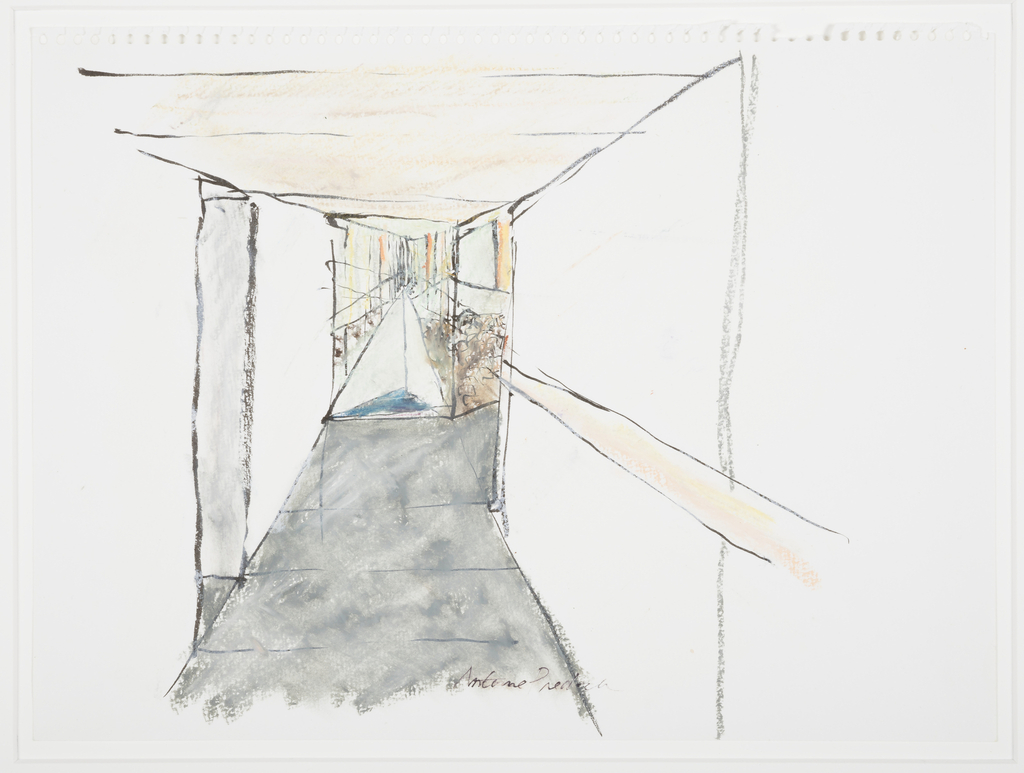
Building a ShoePosted by Allison Grimes, on Friday January 25, 2013Inventor Tinker Hatfield is responsible for the original design concepts of Air Jordan sneakers, one of the most widely recognized and highly coveted products from the 1990s. The jagged line of color on the edge of the sole that became a trademark; the revolutionary “Air” bubble design, a small plastic window in the sole of the shoe which allowed you to see the cushioning system inside, are all ideas that came from one man who seems to know a little more about building than just shoe design. Shoe, sneaker, Tinker Hatfield, nike, Architecture, drawing |
|
Corporate Calico: Angelo Testa’s Fabric for IBMPosted by Ellen Lupton, on Thursday January 24, 2013When IBM premiered its boxy, geometric logotype in 1956, designed by Paul Rand, the idea of a coordinated corporate identity system was just taking off. Indeed, Rand’s logo design set the mark for a new standard of graphic communication in business. A corporate identity was intended to be more than a logo, however: it was conceived as a broader program encompassing signage, letterheads, packaging, publications, and more. IBM, Angelo Testa, branding, logos, Paul Rand, William Golden, CBS |
|
Guerilla FeminismPosted by Alex C-M Kelly, on Wednesday January 23, 2013Do women have to be naked to get into the Met. Museum? is a poster designed by the Guerrilla Girls - a radical feminist collective – in order to draw attention to rampant discrimination against women artists in the curatorial collections of major museums. Legendary for their guerrilla tactics, gorilla masks and take-no-prisoners attitude, the Guerrilla Girls name names and point fingers with no apologies. Guerrila Girls, The Metropolitan Museum of Art, Museum of Modern Art, poster, graphic design, Jean-August-Dominique Ingres, collage |
|
Who is the Man Behind the Design?Posted by Stacey Leonard, on Tuesday January 22, 2013There is—literally—a man behind the design of the post office in Pieter Brattinga’s (1931-2004) De Man Achter de Vormgeving van de P.T.T. This poster is for a 1960 exhibition by the Dutch postal service, the PTT (then the Staatsbedrijf der Posterijen, Telegrafie en Telefonie; now the Koninklijke PTT Nederland). The PTT, founded in the nineteenth century, has promoted contemporary art since the 1920s through stamp designs and by sponsoring exhibitions. Pieter Brattinga, Dutch graphic design, offset lithography, poster, graphic design, layering, Koninklijke PTT Nederland, Netherlands |
|