Object of the Day
Discover a different object from the Museum’s collection every day of the week!
Museum curators, conservators, and educators, as well as design enthusiasts like our teen Design Scholars, docents, and Master’s students, are sharing their favorite objects from Cooper-Hewitt’s incredible collection.
Many of these objects will be featured in the expanded collection galleries when Cooper-Hewitt reopens in 2014. Until then, “Object of the Day” is your uniquely-curated corner of the Museum!
To Tell the TruthPosted by Stephen H. Van Dyk, on Thursday February 07, 2013In the 1930s, Blue Ribbon Books and Pleasure Books, who published a series of colorful pop-up books including The Pop-up Pinocchio, were the first to coin the phrase “pop-up book”. In a five year period, they produced more than ten remarkable pop-up books on classic fairy tales including Goldilocks and the Three Bears, Jack the Giant Killer, Puss in Boots, and Little Red Riding Hood. Each of these titles featured large print text, thick board paper, colorful cartoon-like images and well constructed pop-ups that greatly appeal to chil Blue Ribbon Books, pop-up books, Harold Lentz, Smithsonian Libraries, Pinocchio |
|
Did Hofman have a change of heart?Posted by Elaine Gerstein, on Wednesday February 06, 2013Quirky and interesting, this elevation caught my eye as an object of the day to write about. I was especially drawn to the work, “Elevation Design for a Sitting Room, with Sofa, Two Chairs and Table”, because recently, the Cooper-Hewitt had a wonderful exhibit, House Proud, which was a look into 19th century rooms through watercolors. I wondered if there was any link to these room studies. But, this elevation, also a watercolor, was done later, in 1919. Hofman, hexagon, Rondo, Cubism, Minimalist, decor |
|
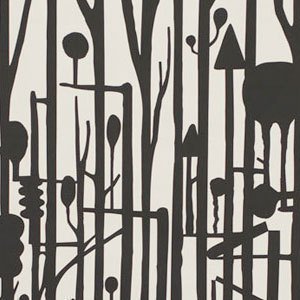
Robinson CrusoePosted by Greg Herringshaw, on Tuesday February 05, 2013I find it interesting that the novel Robinson Crusoe, written by Daniel Defoe in 1719, while not originally intended for a child audience, became the subject of one of the earliest children’s wallpapers. Early children’s wallpapers were designed to be educational and not to amuse. While this book was a novel about travel and adventure and would certainly have appealed to the imaginations of children, it also delivers a strong message of faith. This is the aspect of the novel that would have appealed to manufacturers and parents. wallpaper, Children, Crusoe, washable, intaglio |
|
The Instruments of Christ’s Passion for $2 a YardPosted by Maleyne Syracuse, on Monday February 04, 2013In 1951, Fernand Léger designed seventeen monumental stained glass windows (vitrail, in French), depicting the instruments of Christ’s passion, for the new Eglise du Sacré Coeur in Audincourt, France. In 1955, Léger used the design for one of these windows, Pincers and Nails, as the pattern for Vitrail, a textile produced by Fuller Fabrics. Fernand Léger, Fuller Fabrics, Modern Master Series, L’Eglise de Sacré Coeur Audincourt |
|
Is that really a textile?Posted by Kimberly Cisneros, on Sunday February 03, 2013At first glance, Figures with Still Life, designed by Ruth Reeves, looks like a modern art painting. I did a double take when I realized it was, instead, a screen printed textile on plain weave. Throughout her career, Reeves designed a variety of objects in modern styles including tapestries, wall hangings, wall fabrics, carpeting, and dresses. Ruth Reeves, Art Deco, Cubism, figures representing daily life, wall hanging |
|
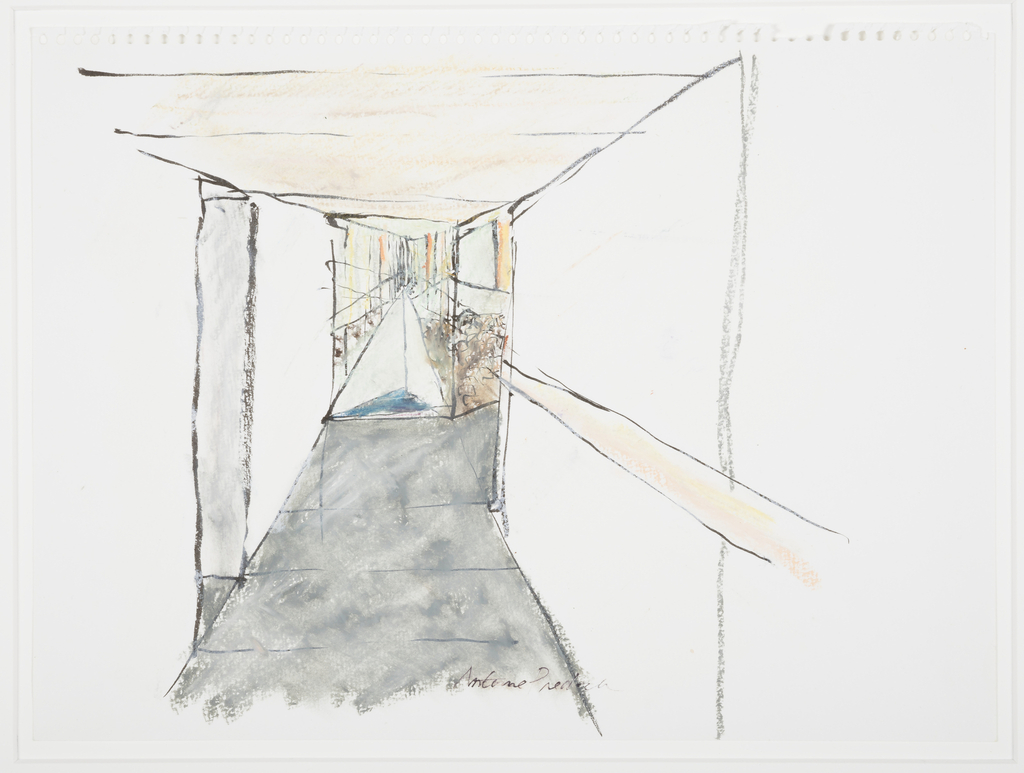
New York ClassicPosted by Cynthia E. Smith, on Saturday February 02, 2013Like thousands of others, I pass through Grand Central Terminal every day on my way to work. Actually I am on a subway train passing below, but in my mind’s eye I picture the magnificent granite and limestone building looming above Park Avenue interrupting the busy boulevard. Even today it stands as an enduring temple to urban transportation, commerce and design. Whitney Warren, Grand Central Terminal, New York City, drawing, Charles Wetmore, Reed and Stern, Architecture, Manhattan, Columbia University, Ecole des Beaux Arts, National Historic Landmark, granite, limestone |
|
Flights of FancyPosted by Susan Brown, on Friday February 01, 2013“Les coquecigrues” features in several French expressions, such as “á la venue des coqucigrues,” which has the meaning and something of the feeling of “when pigs fly.” But this enchanting fabric suggests another expression, “regarder voler les coquecigrues,&rdqu Oberkampf, coquecigrues, Mme. Jules Mallet |
|
TanzstudioPosted by Caitlin Condell, on Thursday January 31, 2013In 1931 when he designed this poster, the Swiss artist, designer, and architect Max Bill had already completed several years of study at the Bauhaus under the guidance of artistic luminaries Oskar Schlemmer, Paul Klee, and Wassily Kandinsky. Bill had returned to Switzerland in 1929, and it was while living in Z&uu Max Bill, poster, graphic design, dance, Käthe Wulff, Mariette von Meyenburg, Bauhaus, Rudolf von Laban, Oskar Schlemmer |
|
Homer and Prouts NeckPosted by Gail S. Davidson, on Wednesday January 30, 2013In April 2005, while writing an essay on Winslow Homer and the American Landscape, I drove up with my husband to Prouts Neck, Maine where Homer had his studio on land that was owned by his family. Homer, along with his father and two brothers, had purchased property on Prouts Neck from 1882 through 1909, for the purpose of creating a family vacation compound and as an investment in one of the most scenic spots along the Atlantic Coast. An easement or “marg Winslow Homer, Prouts Neck, Maine, Portland Museum of Art, American landscape |
|
Good VibrationsPosted by Caitlin Condell, on Tuesday January 29, 2013Stare into the electric blue shades of this woman’s sunglasses and what do you see? Even if you know what you are looking for, the blue letterforms come together to form coherent words only with sustained visual focus. If you were to advertise a concert that you wanted people to come to, would you make it this difficult for your audience to find out about it? Or could it be that the designer had something else in mind? Victor Moscoso, San Francisco, The Chambers Brothers, Josef Albers, Herbert Matter, Yale University, Cooper Union, color theory, New York, poster, lithography, Neon Rose, Wes Wilson, Stanley Mouse, Rick Griffin, typography, graphic design |
|